 AI


VAT return filing in Saudi Arabia: deadlines, mistakes and penalties
When the Saudi VAT return is due, what goes in each box, how to file and pay on ZATCA's portal, a worked quarterly example in SAR, the penalties in the VAT Law, seven common mistakes and how Article 63 lets you correct an earlier return.


Key takeaways
- Returns and payment are due by the last day of the month after the period; monthly above SAR 40 million of taxable supplies, quarterly otherwise.
- A due date on a weekend does not move: the July to September 2026 return is due on Saturday 31 October 2026.
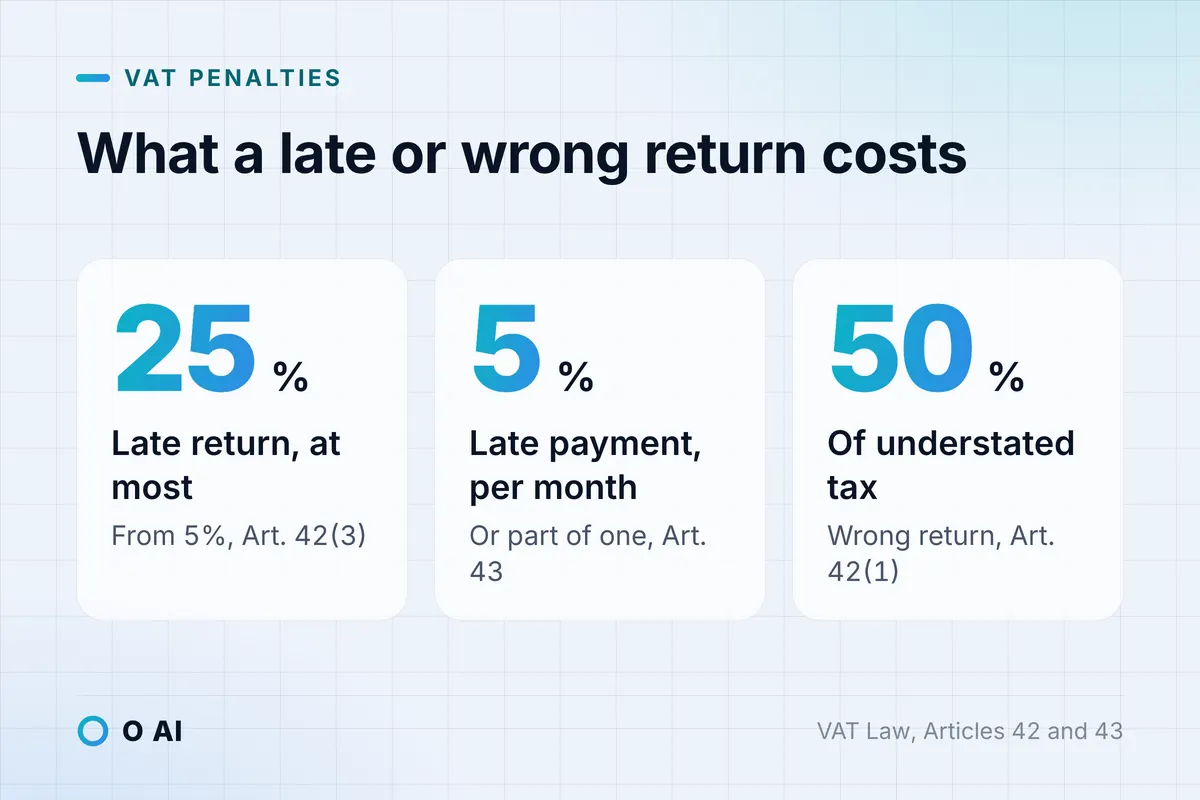
- Late filing costs 5% to 25% of the tax, late payment 5% for each month or part of a month, and an understated return 50% of the difference.
- A net understatement under SAR 15,000 can be corrected in the current return; larger ones need the earlier return corrected within 20 days.
- VAT and income tax fines differ: 5% a month for VAT, 1% for each 30 days for income tax.
On this page
- When is the VAT return due?
- What the VAT return asks for, box by box
- VAT return filing in Saudi Arabia, step by step on ZATCA's portal
- Illustrative example: a quarterly return for a Riyadh trading company
- Penalties for late, missing or wrong VAT returns
- Seven mistakes that lead to corrections or fines
- How to fix a mistake after you file
- If you cannot pay in full, or you have a credit
- A month-end routine before every return
- Your next step
VAT return filing in Saudi Arabia is due by the last day of the month after each tax period: monthly if your taxable supplies exceeded SAR 40 million in the past 12 months, quarterly otherwise [1]. You file and pay online by that date; a late return costs 5% to 25% of the tax due [2].
This guide covers the deadlines, the boxes on the return, the filing steps, a worked example, the penalties and how to fix a mistake. It is general information, not tax advice: confirm a specific case with ZATCA or a licensed tax adviser.
When is the VAT return due?
The Implementing Regulations set two kinds of tax period (Article 58) [1]:
- Monthly, for a business whose taxable supplies exceeded SAR 40 million in the previous 12 months.
- Quarterly, for everyone else. A smaller business may ask ZATCA to move to monthly periods, and after two years on monthly returns it may ask to go back to quarterly if it is still under SAR 40 million.
For both, the return and the payment are due by the last day of the month after the period ends (Articles 59(1) and 62(1)) [1]. There is no grace for weekends: Article 74(1) says returns and payments are due on or before the date whether or not it is a working day [1].
| Quarter (calendar-quarter filer) | Return and payment due |
|---|---|
| January to March | 30 April |
| April to June | 31 July |
| July to September 2026 | 31 October 2026, a Saturday |
| October to December 2026 | 31 January 2027 |
The table assumes quarters that follow the calendar. Your own periods and due dates are listed under Returns on ZATCA's portal [4]. Monthly filers work the same way: on 21 September 2026 ZATCA reminded businesses above SAR 40 million that their August 2026 returns were due by 30 September 2026 [2].
What the VAT return asks for, box by box
The return has three screens after your taxpayer details: VAT on sales, VAT on purchases and total VAT. Each line has an amount, an adjustments column and the VAT [4]. Article 62(2) lists the information ZATCA may ask for in the form [1].
| Box | Line on the return | What goes in it |
|---|---|---|
| 1 | Standard rated sales | Sales taxed at 15% in the Kingdom |
| 2 | Sales on which the government bears the VAT | Only sales covered by a specific decision under which the state pays the VAT on the customer's behalf |
| 3 | Zero rated domestic sales | For example qualifying medicines and medical goods, or investment metals (Articles 35 and 36) |
| 4 | Exports | Goods exported outside the GCC, backed by proof within 90 days (Article 32) |
| 5 | Exempt sales | For example residential rent, real estate sales, or financial services with an implicit margin (Articles 29 and 30) |
| 6 | Total sales | Calculated |
| 7 | Standard rated domestic purchases | Purchases from Saudi suppliers with a valid tax invoice; claim VAT only where it is deductible (Articles 49 and 50) |
| 8 | Imports subject to VAT paid on import | Imports where VAT was paid at customs |
| 9 | Imports subject to VAT accounted for through the reverse charge mechanism | Supplies from non-resident suppliers on which you account for the VAT yourself (Article 47(1)) |
| 10 | Zero rated purchases | Purchases taxed at 0% |
| 11 | Exempt purchases | Purchases with no VAT, such as residential rent |
| 12 | Total purchases | Calculated |
| Total VAT | Total VAT due for the current period, VAT credit from previous periods, corrections from previous periods, net VAT | Calculated, plus the corrections field |
Sources for the table: the form layout comes from ZATCA's user guide [4], and the article references from the Implementing Regulations [1].

VAT return filing in Saudi Arabia, step by step on ZATCA's portal
Filing is free, and ZATCA says it checks returns with AI-powered tools [3]. The user guide sets out these steps [4]:
- On zatca.gov.sa, open E-Services and choose Submit VAT Return.
- Log in with your username and password for companies and establishments, or through Nafath for individuals, then enter the code sent by SMS.
- Click Returns in the side menu, choose VAT and select the return to file.
- Check Taxpayer Details, then click Next.
- Fill in VAT on Sales and VAT on Purchases. You can save a draft at any point.
- Review Total VAT, including the credit carried forward and any corrections from earlier periods.
- Attach supporting documents, and add notes if you wish.
- Review the summary and click Submit & Generate SADAD Bill.
- Download the request form from the confirmation window.
ZATCA confirms receipt and the amount by SMS and email, and you can pay through SADAD, mada or Visa [3]. ZATCA also invites businesses to file and pay through its mobile app [2].
Illustrative example: a quarterly return for a Riyadh trading company
Illustrative example. A Riyadh company that sells office equipment files quarterly. For July to September 2026 its books show the following, all net of credit notes.
| Box | Amount (SAR) | VAT (SAR) |
|---|---|---|
| 1. Standard rated sales | 900,000 | 135,000 |
| 4. Exports to a customer in Jordan, with export proof | 200,000 | 0 |
| 6. Total sales | 1,100,000 | 135,000 |
| 7. Standard rated domestic purchases, deductible part | 500,000 | 75,000 |
| 8. Imports with VAT paid at customs | 150,000 | 22,500 |
| 12. Total purchases | 650,000 | 97,500 |
| Net VAT due | 37,500 |
The company also paid SAR 600 of VAT on a staff dinner. It leaves that out of the deductible input VAT, because Article 50 blocks hospitality the company has no legal duty to provide [1]. The SAR 37,500 is due by Saturday 31 October 2026.
Penalties for late, missing or wrong VAT returns
The penalties sit in the VAT Law, not in the regulations [5].
| What went wrong | Penalty | VAT Law |
|---|---|---|
| Return not filed on time | 5% to 25% of the tax that should have been declared | Article 42(3) |
| Tax not paid on time | 5% of the unpaid tax for each month or part of a month | Article 43 |
| Incorrect return, a return amended after filing, or a document that understates the tax | 50% of the difference; ZATCA may waive or reduce it under rules set by its Board | Article 42(1) and (2) |
| Not applying for registration on time | SAR 10,000 | Article 41 |
| Tax evasion | At least the tax due, up to three times the value of the goods or services | Article 40 |
| Not keeping invoices, books and records | Up to SAR 50,000 for each tax period | Article 45(1) |
| The same violation repeated within three years | The fine may be doubled | Article 47 |
A fine never replaces the tax itself, which remains due (Article 46) [5].
Applied to the example, for illustration only: if the company paid its SAR 37,500 on 10 November 2026, the late-payment fine under Article 43 would be 5%, or SAR 1,875, because part of a month counts as a month. Paying on 3 December 2026 would mean two months or parts of months, or SAR 3,750. A late return could add between SAR 1,875 and SAR 9,375 (5% to 25%). Your actual position, including any fines, appears in the tax account ZATCA keeps for you online (Article 59(5) and (6)) [1].
Late payment fines at «Zakat and Income»: VAT is not income tax
Many people still call ZATCA by its old name, the General Authority of Zakat and Tax, known in Arabic as «الزكاة والدخل» (Zakat and Income). It merged with the General Customs Authority to form ZATCA under Council of Ministers Resolution No. 570 dated 22/9/1442H [7]. One authority now collects several taxes, and their late-payment fines are not the same:
- VAT: 5% of the unpaid tax for each month or part of a month (VAT Law, Article 43) [5].
- Income tax: 1% of the unpaid tax for each 30 days of delay (Income Tax Law, Article 77(a)) [8].
- Zakat: governed by its own regulations, outside the scope of this guide.
Before you dispute or pay a fine, check which tax and which period it belongs to.
Seven mistakes that lead to corrections or fines
- Claiming input VAT without a valid tax invoice. Article 49(7) requires the evidence the rules set, normally a proper tax invoice from a registered supplier [1].
- Claiming blocked costs. Entertainment, staff hospitality with no legal duty, and cars designed for up to 10 people are blocked under Article 50 unless an exception applies [1].
- Forgetting the reverse charge. When a registered business buys a supply from a non-resident supplier and the Agreement puts the tax on the customer, it declares the output VAT and any deductible input VAT itself (Article 47(1)) [1].
- Mixing up exempt and standard-rated sales. Residential rent and real estate sales are exempt under Article 30, while commercial rent is not [1].
- Waiting for Sunday. A due date on a Friday or Saturday does not move (Article 74(1)) [1].
- Putting credit notes in the wrong period. A reduction in output VAT goes into the return for the period of the event or of the credit note, whichever is later; an increase goes into the period of the event (Article 40(4) and (5)) [1].
- Writing off bad debts too early. Output VAT on an unpaid invoice can be reduced only after at least 12 months, for an unrelated customer, with VAT already declared and paid, and with a certificate from a licensed accountant confirming the write-off (Article 40(7)) [1].
How to fix a mistake after you file
Article 63 of the regulations, as amended in November 2024, sets the route by size and direction of the error [1][6]:
- You declared too little, by a net amount under SAR 15,000: add it to the corrections field of the return for the period in which you found the error (Article 63(3)).
- You declared too little, by SAR 15,000 or more: notify ZATCA within 20 days of finding the error by correcting the earlier return (Article 63(1)).
- You declared too much: deduct the amount in a later return. This is not allowed more than five years after the end of the calendar year that contains the period (Article 63(2) and (4)).
ZATCA's guideline on the amendments gives the example of a company that finds a SAR 10,000 understatement and corrects it in the corrections section of the current return [6]. In our example, missing a SAR 60,000 sale from the third quarter means VAT of SAR 9,000, which can go into the fourth-quarter return due on 31 January 2027. Missing a SAR 200,000 sale means SAR 30,000, so the third-quarter return itself must be corrected within 20 days. Because an incorrect return can carry the 50% fine under Article 42(1), correcting early and openly matters; ZATCA has the power to waive or reduce that fine [5].
If you cannot pay in full, or you have a credit
- Instalments: ZATCA may let you pay tax, fines and charges in instalments if you show you cannot pay on time. You apply with supporting documents, ZATCA answers within 20 days, the plan normally runs for no more than 12 months, and the late-payment fine still applies for the extra time (Article 60) [1].
- A credit balance: the return shows any VAT credit from previous periods [4]. You can carry it forward or claim a refund under Article 69, and ZATCA may set a refund against other amounts you owe it [1][6].
A month-end routine before every return
- Reconcile sales invoices and credit notes with the ledger.
- Match each purchase VAT amount to a valid tax invoice and remove blocked items.
- Tie import VAT to the customs declarations.
- List services bought from abroad for the reverse charge.
- File the export evidence for zero-rated sales.
- Look back at earlier periods for errors to correct.
- Pay before the due date, even when it falls on a weekend.
- Save the submission form and the SADAD bill with the working papers.

If most of the time goes on copying figures from scanned purchase invoices, our guide to Arabic OCR for scanned PDFs shows how to extract and check them. For the matching and reconciliation steps, our comparison of AI agents, RPA and workflow tools helps you decide which tool fits each step.
Your next step
Open ZATCA's portal today and note the due date of your next return. For a calendar-quarter filer, VAT return filing in Saudi Arabia for July to September 2026 closes on Saturday 31 October 2026. Book the reconciliation for the week before, set the payment for a working day ahead of the deadline, and keep this guide's penalty table next to your checklist. O AI is a software and AI company in Al Khobar; more about us on our home page. Our ERP and business systems page describes the business systems we build.
Frequently asked questions
When is the VAT return due in Saudi Arabia?
By the last day of the month after the end of the tax period. Businesses whose taxable supplies exceeded SAR 40 million in the previous 12 months file monthly; everyone else files quarterly. For a calendar-quarter filer, the July to September 2026 return and payment are due by 31 October 2026. The date does not move when it falls on a weekend or holiday, so plan to file and pay before it.
What is the penalty for filing a VAT return late?
The VAT Law sets a fine of at least 5% and at most 25% of the tax that should have been declared, for a return not filed within the period. It is separate from the late-payment fine, so a business that files and pays late can face both. Filing an incorrect return is a different violation, with a fine of 50% of the understated tax, which ZATCA may waive or reduce under rules set by its Board.
How is the late payment fine for VAT calculated?
It is 5% of the unpaid VAT for each month or part of a month that the tax remains unpaid after the due date. A payment a few days late therefore costs a full 5%, and a payment just over a month late costs 10%. Instalment plans do not stop the fine from running for the extra time. The amounts charged appear in the tax account ZATCA keeps for each taxpayer.
Is «Zakat and Income» the same as ZATCA?
Yes, in practice. The General Authority of Zakat and Tax, often called «الزكاة والدخل», merged with the General Customs Authority in 2021 to form the Zakat, Tax and Customs Authority, ZATCA. It administers VAT, income tax, zakat and customs, and each has its own rules. The VAT late-payment fine is 5% a month, while the income tax delay fine is 1% for each 30 days, so check which tax a notice concerns.
How do I correct a VAT return I have already filed?
It depends on the direction and size of the error. If you under-declared by a net amount below SAR 15,000, include it in the corrections field of your current return. If the shortfall is SAR 15,000 or more, correct the original return within 20 days of finding the error. Over-declared VAT can be deducted in a later return, within five years of the end of the relevant calendar year.
Can I pay my VAT in instalments?
Possibly. ZATCA may agree to an instalment plan if you show you cannot pay on time or would face hardship paying in one go. You apply with supporting documents, and ZATCA replies within 20 days. Plans normally run for up to 12 months, and the late-payment fine still applies for the period covered. Missing two instalments allows ZATCA to cancel the plan and demand the balance at once.
Can I switch from quarterly to monthly VAT returns?
Yes. A business under the SAR 40 million threshold can apply to ZATCA to use monthly periods, and the change starts from the period after approval. After two years of monthly filing it can ask to return to quarterly periods, provided its supplies are still under SAR 40 million. Monthly filing also means a reconciliation and a return every month instead of every quarter.
How this article was made: Researched from the sources listed below, opened on 14 October 2026. Drafted with AI assistance, then checked against those sources. General information, not professional advice. Images are AI-generated illustrations.
Sources
- Implementing Regulations of the VAT Law, official Arabic text, tenth edition, April 2025 (opens in a new tab)Zakat, Tax and Customs Authority (ZATCA) · zatca.gov.sa
- ZATCA Urges Establishments to Submit VAT Returns for August 2026 (21 September 2026) (opens in a new tab)Zakat, Tax and Customs Authority (ZATCA) · zatca.gov.sa
- Submit VAT Return (e-service) (opens in a new tab)Zakat, Tax and Customs Authority (ZATCA) · zatca.gov.sa
- User guide: Submit VAT Return Service (opens in a new tab)Zakat, Tax and Customs Authority (ZATCA) · zatca.gov.sa
- Value Added Tax Law, with amendments (in Arabic) (opens in a new tab)Bureau of Experts at the Council of Ministers · laws.boe.gov.sa
- Guideline for Amendments to the Implementing Regulation of VAT, Board Resolution 01-06-24, Issue 1, April 2025 (opens in a new tab)Zakat, Tax and Customs Authority (ZATCA) · zatca.gov.sa
- Statute of the Zakat, Tax and Customs Authority, Council of Ministers Resolution No. 570 (in Arabic) (opens in a new tab)Bureau of Experts at the Council of Ministers · laws.boe.gov.sa
- Income Tax Law (in Arabic) (opens in a new tab)Bureau of Experts at the Council of Ministers · laws.boe.gov.sa
About the author
Newsletter
New guides and news by email
New guides and news about O AI, Rushd and Dalni, at most twice a month. No spam.