 AI


Construction accounting software: progress claims, retentions and project costing
Treat each project as a profit centre: budgets by cost code, commitments, progress claims (mustakhlas), retentions and advance recoveries. This guide follows ZATCA's May 2026 contracting guideline, with a worked SAR claim, a contract checklist and dated prices.


Key takeaways
- ZATCA treats a progress claim (mustakhlas) as a sign the supply occurred, not as a tax invoice; the tax invoice is due within 15 days after the month end.
- If the contractor invoices the full amount due, VAT is due on all of it, including retention withheld; releasing the retention later needs no new invoice or VAT.
- VAT on an advance is due when it is received; later e-invoices adjust the advance by referring to the original advance payment invoice.
- On government contracts under the procurement law, VAT is due on the payment order date or payment, whichever is earlier, for the main contractor only.
- The Saudi Contractors Authority offers 36 electronic model contracts for small and medium projects on its Muqawil platform, with escrow payments.
On this page
- Why contractors outgrow general accounting software
- Project costing: budgets, cost codes and commitments
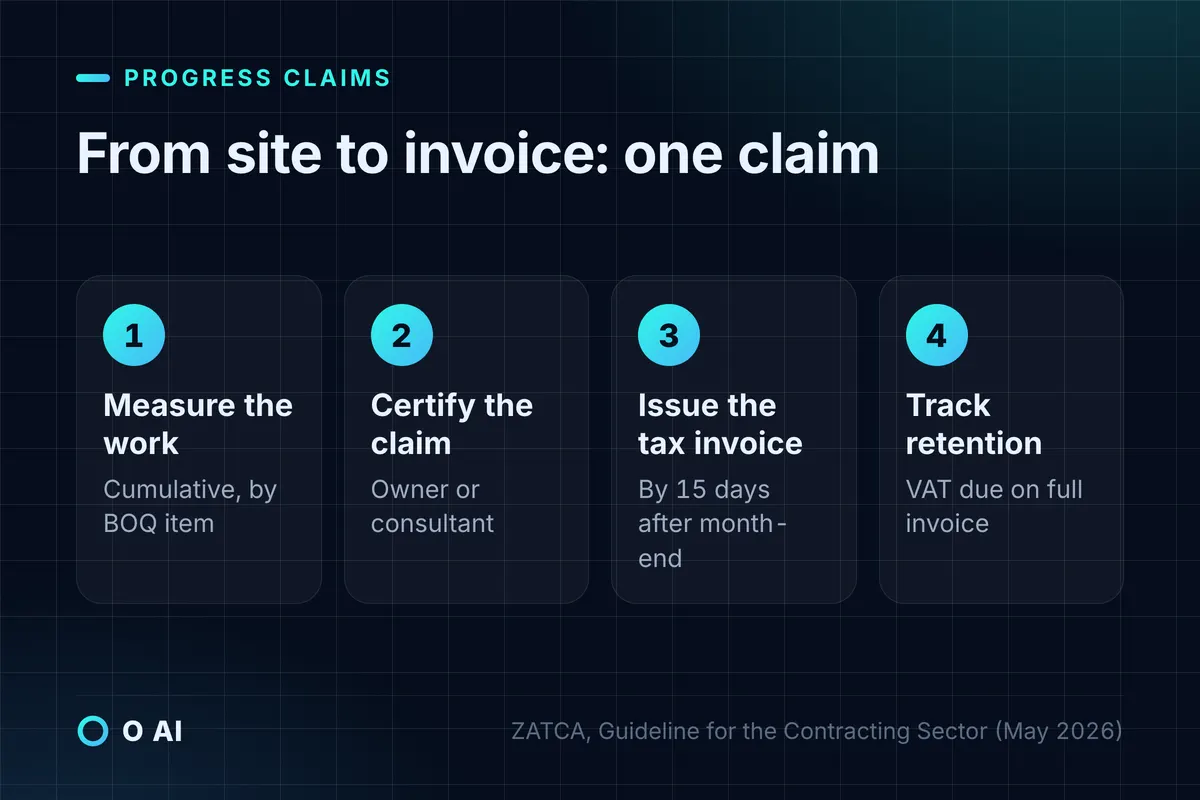
- Progress claims (mustakhlas): from site measurement to tax invoice
- Retentions and advance payments: the VAT treatment
- Subcontractors: the same rules in reverse
- Construction contract template: what your accounts need from it
- A checklist for choosing construction accounting software
- What construction accounting software costs (prices checked 14 October 2026)
- Your next step
Construction accounting software has to treat every project as its own profit centre: a budget by cost code, commitments to suppliers and subcontractors, progress claims, retentions and advance recoveries, and VAT on every invoice. General accounting software records the invoice; construction accounting software also tracks the claim, the retention and the cost to complete.
This guide is for owners, finance managers and quantity surveyors at contracting companies in Saudi Arabia, from small fit-out firms to general contractors. It explains how project costing works, how progress claims (mustakhlas) and retentions are treated for VAT according to ZATCA's guideline for the contracting sector, what a construction contract must state for your accounts to work, and what to check in software. Rules and prices were checked on official pages on 14 October 2026. It is general information, not tax, accounting or legal advice.
Why contractors outgrow general accounting software
A shop sells, invoices and collects in the same week. A contractor signs a contract worth millions, spends for months before the first payment, invoices by measured progress, waits for certification, has part of every payment withheld as retention, recovers an advance claim by claim, and pays subcontractors under the same terms in reverse. A general ledger shows the company's total profit; it cannot show which project is losing money until it is too late.
| Question | General accounting software | Construction accounting software |
|---|---|---|
| Is this project on budget? | Only if you code every cost to a project by hand | Budget, actual and forecast by project and cost code |
| What have we committed but not yet been invoiced for? | Not visible | Purchase orders and subcontracts recorded as commitments |
| How much have we claimed and been certified? | Only the invoices issued | Cumulative claim history per contract |
| How much retention is owed to us, and when? | Mixed into receivables | A retention ledger by project with release dates |
| What do we owe subcontractors in retention? | Mixed into payables | Subcontractor retention payable by contract |
| What will the project finally earn? | Not available | Forecast final cost and margin |
Project costing: budgets, cost codes and commitments
Project costing starts before the first purchase. Break the contract budget into cost codes that follow how the work is priced and measured, usually the sections of the bill of quantities, such as earthworks, concrete and steel, mechanical and electrical works, and finishes. Then give every cost a type: materials, labour, equipment, subcontract or site overheads.
Three habits make the numbers useful:
- Record commitments when you sign, not when you are invoiced. A subcontract for SAR 900,000 is a cost the project will carry, even if the first invoice arrives in three months.
- Allocate labour and equipment weekly. Timesheets and equipment logs by project and cost code, or site costs end up in head-office overheads.
- Forecast the cost to complete every month. The site team estimates what each cost code still needs; the software adds it to actual cost to give the forecast final cost.
Illustrative example: a mid-project cost report
Illustrative example. A contractor in Dammam is building a SAR 4,000,000 commercial building (excluding VAT) with a budgeted cost of SAR 3,400,000, a planned margin of 15%.
| Cost code | Budget (SAR) | Actual to date (SAR) | Estimate to complete (SAR) | Forecast final (SAR) | Variance (SAR) |
|---|---|---|---|---|---|
| Earthworks and foundations | 600,000 | 590,000 | 0 | 590,000 | +10,000 |
| Concrete and steel structure | 1,300,000 | 820,000 | 560,000 | 1,380,000 | −80,000 |
| Mechanical and electrical (subcontract) | 900,000 | 250,000 | 650,000 | 900,000 | 0 |
| Finishes | 600,000 | 0 | 620,000 | 620,000 | −20,000 |
| Total | 3,400,000 | 1,660,000 | 1,830,000 | 3,490,000 | −90,000 |
The forecast margin is now SAR 4,000,000 − SAR 3,490,000 = SAR 510,000, or 12.75%, against the 15% planned. The report shows where the overrun sits, the structure, while there is still time to act: a variation claim for extra steel, a cheaper supplier for finishes, or a tighter pour schedule.
Revenue in the accounts
In the financial statements, IFRS 15 recognises revenue as promised goods or services are transferred to the customer; where an obligation is satisfied over time, the entity selects a measure of progress to decide how much revenue to recognise in each period [1]. In Saudi Arabia, SOCPA requires full IFRS as endorsed in the Kingdom for publicly accountable entities, and the IFRS for SMEs standard for small and medium entities [2]. Your accountant chooses the measure of progress; the software's job is to supply the data it needs, such as costs to date and the forecast total cost of each project.
Progress claims (mustakhlas): from site measurement to tax invoice
ZATCA's guideline for the contracting sector describes the completion report, known in Saudi practice as the mustakhlas, as the document a supplier issues to set the amount payable for a part of a project and to obtain the customer's approval for payment [3]. Construction services are services related to real estate and are subject to VAT at 15% [3].
The guideline then sets out how the claim relates to VAT [3]:
- The claim is not a tax invoice, but it is treated as a sign that the supply has occurred, and it is used to determine the date tax is due for the executed part of the work.
- Construction is a continuous supply. Where the contract fixes payment dates, VAT is due on the payment due date or the invoice date, whichever is earlier, and at least once in every 12 consecutive months. In other cases, VAT is due for each interim payment on the date of the tax invoice or the payment, whichever is earlier.
- The tax invoice deadline. The supplier must issue a tax invoice within 15 days after the end of the month in which the supply was made.
- Adjustments that change the tax require a credit note or debit note.
Contracts with government entities under the Government Tenders and Procurement Law follow a special rule: VAT is due on the date the payment order for the claim is issued or the date payment is received, whichever is earlier. ZATCA states that this rule applies only to the main contractor contracting directly with the government entity, not to its subcontractors [3].
E-invoicing adds its own steps. In Phase 2, a standard tax invoice to a business must be submitted to ZATCA's Fatoora platform for clearance, which adds a cryptographic stamp and QR code before the invoice is shared with the buyer [4]. On 24 July 2026, ZATCA announced that Wave 25 covers taxpayers whose VAT-taxable revenue exceeded SAR 187,500 in any of 2022, 2023, 2024 or 2025, with integration due by 1 February 2027 [5].
Retentions and advance payments: the VAT treatment
Retention is the part of each payment the customer withholds as a performance guarantee; ZATCA describes it as held until a building completion certificate is issued. ZATCA's guideline treats retention amounts as part of the payments due to the supplier under the contract. If the supplier issues a tax invoice, or any document requesting payment of the full amount due, VAT is due on the entire invoiced amount, even though the customer withholds the retention. When the retention is later paid, there is no obligation to issue a new invoice or declare VAT again [3]. ZATCA's own example uses a 6% retention [3].
Advance payments work the other way round. VAT becomes due when the advance is received, and the contractor must issue a tax invoice for it [3]. Under the e-invoicing rules, the advance is invoiced as an advance payment invoice, and later invoices adjust the value on which VAT was already paid, with a reference to the advance invoice [4].
Two related cases from the same guideline:
- Security deposits and bank guarantees held in a separate account that the supplier cannot use until a specific event are not treated as consideration; VAT arises only when the money becomes available for use [3].
- Liquidated damages for late completion that the contract links to performance are treated as a reduction in the contract price, and the supplier issues a credit note including VAT [3].
This section is general information; for your contract, check ZATCA's guideline or ask a licensed tax advisor.
Illustrative example: claim No. 3 with retention and advance recovery
Illustrative example. The percentages are assumptions; your contract sets them. On the SAR 4,000,000 contract above, the owner paid a 10% advance of SAR 400,000 at the start, which the contractor invoiced and declared VAT on when received. Each claim recovers 10% of the work certified, and the owner withholds 5% of each invoice total, including VAT, as retention, the way ZATCA's example calculates it.
| Line | Calculation | SAR |
|---|---|---|
| Work certified to date | Cumulative measurement | 1,800,000 |
| Less work certified in claims 1 and 2 | (1,200,000) | |
| Work in this claim | 600,000 | |
| Less advance recovered | 10% × 600,000 | (60,000) |
| Value of this tax invoice before VAT | 540,000 | |
| VAT at 15% | 540,000 × 15% | 81,000 |
| Tax invoice total | 621,000 | |
| Less retention withheld | 5% × 621,000 | (31,050) |
| Payable now | 589,950 |
The contractor declares VAT of SAR 81,000 on this invoice in full, although SAR 31,050 is withheld. The retention ledger rises by SAR 31,050, and the unrecovered advance falls to SAR 220,000 (SAR 400,000 less 10% of SAR 1,800,000). When the retention is released, it is cash only: no new invoice and no new VAT [3]. Software that cannot hold these three balances per contract leaves them to a spreadsheet, and that is where claims get paid twice or retentions are forgotten.
Subcontractors: the same rules in reverse
A subcontractor's supply to the main contractor is a separate supply subject to VAT at 15%, and the main contractor may deduct that VAT as input tax [3]. In the software, each subcontract needs the same structure as a customer contract, seen from the other side:
- the subcontract value and its commitment against your cost codes;
- the subcontractor's claims, checked against your own measurement before approval;
- the retention you withhold from them, held as a liability until release;
- any advance you paid and its recovery;
- back-charges, such as materials you supplied or rework you paid for, documented with the subcontractor's agreement.
Construction contract template: what your accounts need from it
The contract is the source of every rule your software applies. The Saudi Contractors Authority offers electronic model contracts through its Muqawil platform: 36 model contracts for small and medium construction projects, seven of them in two versions, each made up of a main contract document, special conditions and technical specifications. Payments run through an escrow account: the owner pays each instalment into it, and the money is transferred to the contractor once the owner's conditions for that stage are met. The page states there is currently no fee to create a contract and that the service is for member contractors [6]. For disputes, the authority's Wifaq platform lets contract parties submit settlement requests and manage the dispute through a specialist mediator [7].
Whatever template you use, these terms must be clear before the first claim, because the software needs each one:
- contract value, whether it includes VAT, and whether the customer is a government entity;
- claim frequency, measurement basis and who certifies;
- advance payment percentage and how it is recovered;
- retention percentage, its base (with or without VAT) and the events that release it;
- variation orders: who approves them and how they are priced;
- liquidated damages and security deposits or bank guarantees;
- payment terms after certification.
This is a checklist for accounting set-up, not legal advice; have a lawyer review the contract itself.

A checklist for choosing construction accounting software
Ask each vendor to demonstrate these with one of your real projects.
- Budgets by project and cost code, with commitments from purchase orders and subcontracts.
- Monthly cost-to-complete forecasts and a forecast final margin per project.
- Cumulative progress claims per contract, with certified amounts and claim history.
- Retention receivable and payable ledgers with release dates and reminders.
- Advance payments invoiced, with recovery tracked claim by claim and linked in e-invoices [4].
- Tax invoices issued from the certified claim within 15 days after month end [3].
- Phase 2 clearance of standard tax invoices through Fatoora [4].
- Credit and debit notes for adjustments and liquidated damages [3].
- Subcontract management: claims, retentions, back-charges and input VAT.
- Labour and equipment costs allocated to projects from timesheets and logs.
- Separate tax-point handling for government contracts [3].
- Reports your accountant can use for revenue recognition: costs to date and forecast total cost per project [1].
What construction accounting software costs (prices checked 14 October 2026)
If a contractor-specific system does not publish prices, ask for a written quote that lists the modules for claims, retentions and subcontracts, the number of users and projects, and implementation costs. As a dated example of a general accounting package with project features, not a recommendation: on 14 October 2026, the Saudi pricing page of Zoho Books listed plans per organisation per month billed annually at SAR 60 (Standard), SAR 90 (Professional), SAR 120 (Premium), SAR 280 (Elite) and SAR 660 (Ultimate), or SAR 69, SAR 129, SAR 159, SAR 349 and SAR 799 billed monthly, excluding local taxes, with extra users at SAR 8 per user a month billed annually [8]. The page describes the Professional plan as the tier for taking on projects, tracking inventory and handling purchases.
A general package like this can carry project budgets and costs; check whether it can also hold claims, retentions and advance recoveries per contract, or whether those would stay in a spreadsheet beside it.

Your next step
This month, take your largest live project and build three lists: a cost report by cost code with a cost-to-complete estimate, the retention owed to you and by you with release dates, and the advance still to be recovered. Then check that the tax invoices for your last three claims were issued within 15 days after the month end. Use that project, with its real numbers, as the test case for any construction accounting software you consider. If subcontractor invoices and delivery notes still arrive as scans, our guide to Arabic OCR explains how to turn them into reliable data, and our guide to custom software development in Saudi Arabia covers when connecting or building beats buying. You can read more about O AI, a software and AI company in Al Khobar, on our home page. Our ERP and business systems page describes the business systems we build.
Frequently asked questions
Is a progress claim (mustakhlas) a tax invoice?
No. ZATCA's guideline for the contracting sector says the completion report, or mustakhlas, is not treated as a tax invoice. It is the document that sets the amount payable for part of the project and asks the customer to approve it. It is, however, treated as a sign that the supply has occurred and is used to determine when VAT is due, and the contractor must still issue a tax invoice within 15 days after the end of the month in which the supply was made.
Is VAT due on retention before the customer pays it?
If the contractor issues a tax invoice for the full amount due, VAT is due on the whole invoiced amount, including the part the customer withholds as retention, according to ZATCA's contracting guideline. When the retention is released later, no new invoice is issued and no further VAT is declared. How your contract and invoices present retention therefore decides the timing, so confirm your treatment with ZATCA's guidance or a licensed tax advisor.
How is VAT handled on an advance payment in a construction contract?
VAT is due when the advance is received, and the contractor must issue a tax invoice for it. Under ZATCA's e-invoicing guidelines, later invoices that recover the advance adjust the value on which VAT was already paid and refer to the original advance invoice, so the same amount is not taxed twice. Your software should track the advance balance per contract and show the recovery on each claim.
When is VAT due on a government construction contract?
For contracts with government entities under the Government Tenders and Procurement Law, ZATCA's guideline says VAT is due on the date the payment order for the claim is issued or the date payment is received, whichever is earlier. The rule applies only to the main contractor contracting directly with the government entity; a subcontractor working for that main contractor follows the normal rules.
Is there an official construction contract template in Saudi Arabia?
The Saudi Contractors Authority offers 36 electronic model contracts for small and medium construction projects through its Muqawil platform. Each contract has a main document, special conditions and technical specifications, and payments run through an escrow account released as the owner's stage conditions are met. The service is for member contractors, and the page stated there was currently no fee. Have a lawyer review any contract before you sign.
Can a contracting company use general accounting software?
A small contractor with a few projects at a time can, if every cost is coded to a project and claims, retentions and advances are tracked carefully. The risk grows with the number of projects and subcontractors: retention release dates are missed, advances are not fully recovered, and losses on one project hide inside company totals. Test any package with one real project, including a claim with retention, before you commit.
How this article was made: Researched from the sources listed below, opened on 14 October 2026. Drafted with AI assistance, then checked against those sources. General information, not professional advice. Images are AI-generated illustrations.
Sources
- IFRS 15 Revenue from Contracts with Customers (opens in a new tab)IFRS Foundation · ifrs.org
- Use of IFRS Accounting Standards by jurisdiction: Saudi Arabia (profile updated 28 July 2022) (opens in a new tab)IFRS Foundation · ifrs.org
- Guideline for the Contracting Sector under VAT Provisions, Second Issue (May 2026) (opens in a new tab)Zakat, Tax and Customs Authority (ZATCA) · zatca.gov.sa
- Detailed Guidelines for E-Invoicing, Version 2 (May 2023) (opens in a new tab)Zakat, Tax and Customs Authority (ZATCA) · zatca.gov.sa
- ZATCA determines the criteria for selecting the targeted taxpayers in Wave 25 of the e-invoicing integration phase (24 July 2026) (opens in a new tab)Zakat, Tax and Customs Authority (ZATCA) · zatca.gov.sa
- Electronic model contracts (in Arabic) (opens in a new tab)Saudi Contractors Authority, Muqawil platform · muqawil.org
- E-services for contractors (in Arabic) (opens in a new tab)Saudi Contractors Authority · sca.sa
- Zoho Books pricing (Saudi Arabia) (opens in a new tab)Zoho · zoho.com
About the author
Newsletter
New guides and news by email
New guides and news about O AI, Rushd and Dalni, at most twice a month. No spam.