 AI


Restaurant POS and accounting software: recipe costing, inventory and billing
Cost every dish from its recipe, compare what the kitchen should have used with what it did use, and set the till up for VAT-inclusive menu prices and ZATCA e-invoicing. With worked SAR examples, a 12-point feature checklist and dated prices.

Key takeaways
- Measure food cost against the menu price before VAT: a SAR 28.75 dish is SAR 25.00 of revenue, so a SAR 8.03 recipe cost is 32.1%, not 27.9%.
- Cost each ingredient per usable unit: purchase price divided by yield. Chicken at SAR 22 a kilo with a 70% yield costs SAR 31.43 per usable kilo.
- Compare theoretical usage from recipes with actual usage from counts; a 10% gap on one ingredient can cost hundreds of riyals a week.
- Menu prices must include VAT, issued invoices cannot be deleted, and refunds go through credit notes under ZATCA's rules.
- In one dated example, inventory and accounting sat in a higher tier than the entry POS bundle; check which tier includes recipe-based stock control.
On this page
- What restaurant POS and accounting software has to cover
- Recipe costing: price every dish from its ingredients
- Restaurant inventory: from recipe to stock count
- VAT and e-invoicing in a restaurant
- POS features a restaurant needs: a checklist
- What restaurant systems cost: a dated example
- Month-end close for a restaurant: seven steps
- Your next step
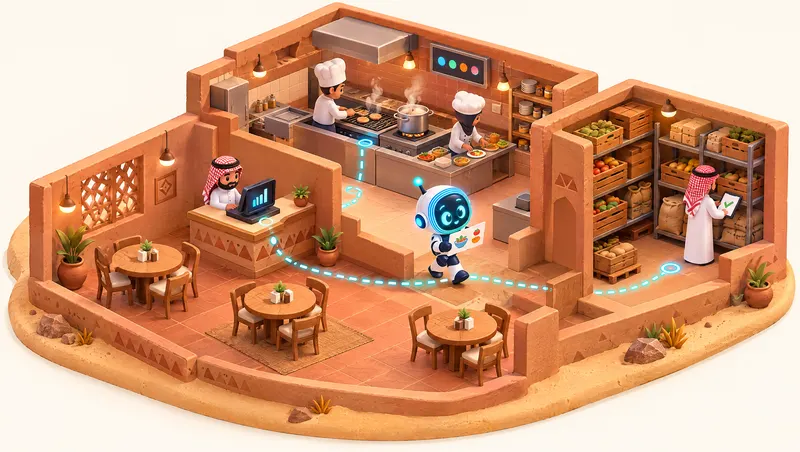
Restaurant POS and accounting software should do four jobs in one flow: take orders and payments, issue ZATCA-compliant simplified invoices, deduct ingredients from stock through recipes, and post each day's sales to the accounts. Choose a system that costs every menu item from its recipe, so you see food cost daily, not at month end.
This guide is for owners and managers of restaurants, cafés, cloud kitchens and food trucks in Saudi Arabia. It shows how to cost a dish from its recipe, how to find the gap between what the kitchen should have used and what it did use, what VAT and e-invoicing rules mean for a restaurant till, and what to look for in software. Rules and prices were checked on official pages on 14 October 2026. It is general information, not accounting or tax advice.
What restaurant POS and accounting software has to cover
A restaurant runs three operations at once: the dining room or counter, the kitchen and the back office. Good software connects them, so a single order changes the bill, the kitchen screen, the stock and the accounts without anyone typing it twice.
| Area | What the software does | Why it matters |
|---|---|---|
| Front of house | Menu, modifiers ("no onion", "extra sauce"), combos, tables, split bills, payments | Correct bills, faster service |
| Kitchen | Kitchen display or printed tickets, preparation times, order status | Fewer lost or wrong orders |
| Stock and purchasing | Recipes, ingredient stock per branch, purchase orders, receiving, waste | Food cost you can see and control |
| Invoicing | Simplified tax invoices with QR codes, credit notes, reporting to ZATCA | Compliance with e-invoicing rules |
| Accounting | Daily sales by payment method, VAT, supplier bills, payroll, branch results | Monthly profit you can trust |
Many systems cover the first two well and leave the last three to spreadsheets. That gap is where restaurant margins disappear.
Recipe costing: price every dish from its ingredients
A recipe card in the system lists, for each menu item, every ingredient, the quantity per portion and the cost of that quantity. The system then multiplies through: when the price of chicken changes on a supplier invoice, the cost of every dish that uses chicken changes with it.
Three details make the difference between a useful recipe cost and a misleading one:
- Yield. You buy 1 kg of raw chicken but serve less after trimming and cooking. Cost the usable quantity, not the purchased one.
- Everything on the plate. Bread, sauces, garnish and packaging for takeaway and delivery are part of the cost.
- The right selling price. Menu prices include VAT, so food cost must be measured against the price before VAT.
Illustrative example: costing a chicken shawarma plate
Illustrative example. The purchase prices below are assumptions for the example, not market prices. A restaurant in Jeddah sells a chicken shawarma plate for SAR 28.75 on the menu, VAT included.
| Ingredient | Purchase price | Yield | Portion | Cost |
|---|---|---|---|---|
| Boneless chicken thigh | SAR 22.00 per kg | 70% after trimming and cooking | 150 g cooked | SAR 4.71 |
| Saj bread | SAR 0.25 each | 100% | 2 pieces | SAR 0.50 |
| Garlic sauce | SAR 12.00 per kg | 100% | 40 g | SAR 0.48 |
| Pickles | SAR 8.00 per kg | 100% | 30 g | SAR 0.24 |
| Frozen fries | SAR 9.00 per kg | 90% after frying | 150 g served | SAR 1.50 |
| Box and bag | SAR 0.60 per set | 100% | 1 set | SAR 0.60 |
| Total cost per plate | SAR 8.03 |
The chicken line works like this: SAR 22.00 ÷ 70% = SAR 31.43 per usable kilo, and 150 g of that costs SAR 4.71.
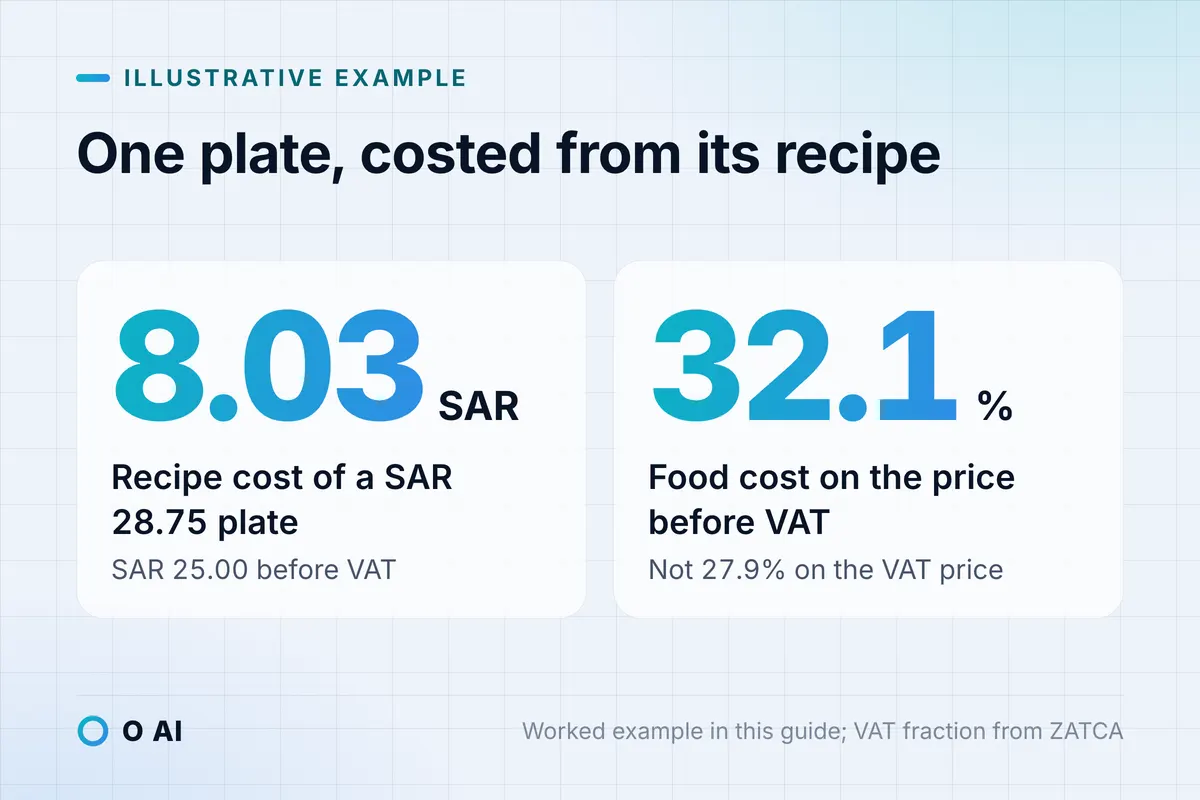
Now the selling side. The VAT inside a VAT-inclusive price is the price × 15/115, and the value before VAT is the price × 100/115 [1]. So SAR 28.75 is SAR 25.00 before VAT plus SAR 3.75 VAT. Food cost is SAR 8.03 ÷ SAR 25.00 = 32.1% of the price before VAT, and the gross profit per plate is SAR 16.97.
An easy mistake is to divide by the menu price with VAT: SAR 8.03 ÷ SAR 28.75 = 27.9%. That figure looks four points healthier than the truth, and every pricing decision built on it inherits the mistake.
Keep recipe costs current
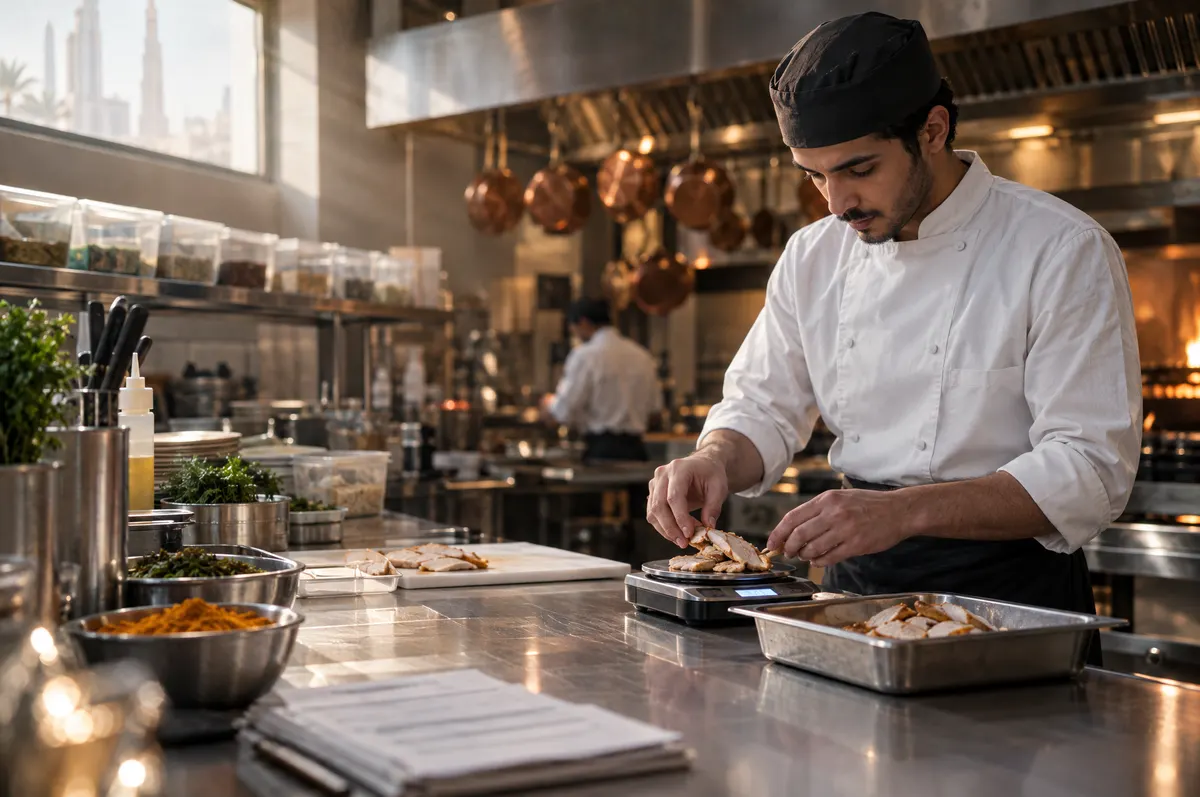
Run a yield test on your main proteins every quarter: weigh what you buy, trim and cook it, and weigh what you can serve. Update the recipe when the yield or the supplier price moves. A system that reads supplier invoices into stock at their actual price keeps recipe costs current without anyone re-entering them.
Restaurant inventory: from recipe to stock count
Recipes let the software calculate theoretical usage: what the kitchen should have used for the dishes it sold. Your stock count gives actual usage: opening stock plus purchases minus closing stock. The gap between the two is the number that tells you about portioning, waste, recording errors and theft.
Illustrative example: a weekly variance check on chicken
Illustrative example. The same restaurant sold 700 shawarma plates in a week. At 150 g cooked and a 70% yield, each plate needs about 214 g of raw chicken, so theoretical usage is about 150 kg. The count shows opening stock of 40 kg, purchases of 160 kg and closing stock of 35 kg: actual usage of 165 kg.
The variance is about 15 kg, or 10% of theoretical usage. At SAR 22 per kilo, that is about SAR 330 a week from one ingredient. The manager checks portion sizes at the grill, the waste log and the receiving notes before suspecting anything else.
Practical rules for kitchen stock:
- Count high-value items often. Proteins, cheese and oils weekly or even daily; dry goods monthly.
- Log waste and staff meals. If it is not recorded, it shows up as unexplained variance.
- First expired, first out. Store and use by expiry date, and record expiry dates at receiving.
- Write down spoiled stock. Under IAS 2, inventory is measured at the lower of cost and net realisable value, and write-downs and losses are expensed in the period they occur [2].
- Keep a record of losses for VAT. ZATCA's retail guideline says lost, stolen or damaged stock normally needs no VAT adjustment, but the loss must be recorded in the accounts, and ZATCA may ask for evidence such as a police report or insurance documents [1].
VAT and e-invoicing in a restaurant
Restaurants deal with VAT on every order, so the till's settings matter. This section is general information; for a specific case, check ZATCA's guidance or ask a licensed tax advisor.
- Menu prices include VAT. ZATCA's retail guideline states that displayed prices must include VAT, and the VAT amount on an invoice is rounded to the nearest halala [1]. Set menu items in the POS at their VAT-inclusive price.
- A simplified invoice for each order. For consumers, a simplified tax invoice must show at least the date of issue; the supplier's name, address and tax identification number; a description of what was supplied; the amount payable; and either the VAT amount or a statement that the price includes VAT [1].
- Electronic from the start. Phase 1, in force since 4 December 2021, requires invoices to be generated through a compliant electronic solution; a scanned or copied paper invoice does not count [3].
- Phase 2 adds the stamp, the QR code and the 24 hours. Once your business is in the integration phase, the till stamps each simplified invoice, adds a QR code, gives the customer a printed copy immediately (or an electronic one if agreed), and reports it to ZATCA's Fatoora platform within 24 hours [4].
- Cancellations and refunds. An issued invoice cannot be deleted or edited; it is cancelled by a credit note, and a new invoice is issued if needed [4]. Check how the POS handles an order returned to the kitchen after the bill was printed.
- Catering for companies. A standard tax invoice to a business is cleared by Fatoora before it is shared; a simplified invoice may be used for a business buyer only when the taxable supply is under SAR 1,000 [4].
The deadline that matters for many smaller restaurants: ZATCA's Wave 25 covers taxpayers whose VAT-taxable revenue exceeded SAR 187,500 in any of 2022, 2023, 2024 or 2025, and they must integrate with Fatoora by 1 February 2027 [5]. ZATCA's list of e-invoicing solution providers is indicative and not an approval; any provider whose solution meets the requirements may be used [6].
Delivery apps: reconcile every payout
If you sell through delivery platforms, the platform's payout is not your sales figure. Record each delivery order in the POS at its full price, record the platform's commission and fees as a cost backed by the platform's tax invoice, and match the payout to both every week. Unmatched orders, refunds charged back to you and promotions you co-funded are where the money leaks.
POS features a restaurant needs: a checklist
Use this list during demos, and ask to see each item working, not described.
- Menu with modifiers, combos and prices by branch and time of day.
- Table plan, split bills and transfer of items between tables.
- Kitchen display or printer routing by station (grill, fryer, drinks).
- Recipes with yields that deduct ingredients from stock on every sale.
- Purchase orders, receiving at invoice price, transfers from a central kitchen.
- Waste and staff-meal recording with reasons.
- Simplified invoices in Arabic with Phase 2 stamping, QR code and offline reporting within 24 hours [4].
- Credit notes for refunds, with no option to delete a sale [4].
- Card payments at the table or counter: SAMA's mada services include contactless payment and accepting cards on Android phones without a dedicated terminal [7].
- Daily sales by payment method and channel, exported or posted to the accounts.
- Theoretical against actual usage reports by ingredient and branch.
- Named user logins with roles, so every void and discount has a name on it [4].
What restaurant systems cost: a dated example
As a dated example, not a recommendation: on 14 October 2026, the pricing page of Foodics, a restaurant management system, showed prices in Saudi riyals by type of outlet [8].
| Bundle shown for "QSR & Cafes" | Billed annually | Billed monthly | What the page lists |
|---|---|---|---|
| Starter | SAR 392 a month | SAR 423 a month | Cloud POS, menu management, kitchen display, customer display, payment services, reports |
| Basic | SAR 742 a month | SAR 801 a month | Starter plus inventory, accounting and HR, online ordering website |
| Advanced | SAR 1,133 a month | SAR 1,224 a month | Basic plus loyalty, business intelligence dashboards and API integration |
The same page showed cloud kitchen bundles at SAR 567 and SAR 867 a month billed annually, and a dine-in bundle at SAR 1,096 a month billed annually that includes table management, waiter features, a warehouse module and pay at the table [8]. The page did not state whether prices include VAT or what one subscription covers per branch, and it said quotes are built around the hardware and software you choose.
The pattern is the useful part. In this example, inventory and accounting are not in the entry bundle, and recipe-based stock control depends on them.
Illustrative example: is the higher tier worth it?
Illustrative example. Moving from the Starter to the Basic bundle above costs (SAR 742 − SAR 392) × 12 = SAR 4,200 a year, billed annually. The chicken variance in the earlier example, about SAR 330 a week, is about SAR 17,160 over 52 weeks from one ingredient. If recipe-based stock control halves that variance, the upgrade more than pays for itself; if nobody will count stock or read the variance report, it will not.
Month-end close for a restaurant: seven steps
- Reconcile sales and money. POS sales by payment method against cash counted, card settlements and delivery payouts.
- Count stock. A full count of food and packaging on the last night of the month.
- Compare theoretical and actual usage for the top 20 ingredients, and explain the largest gaps.
- Post supplier bills with their tax invoices, so input VAT is supported.
- Review food cost by menu category against the price before VAT.
- Check VAT from the POS against the figures for your return; ZATCA's guideline requires VAT records to be kept for at least six years [1].
- Update recipe costs and menu prices where supplier prices or yields have moved.
Your next step
This week, cost your five best-selling dishes from their recipes, using real supplier prices and a yield test on the main protein, and divide each cost by the menu price before VAT. Then count those five dishes' main ingredients for one week and compare theoretical with actual usage. The result tells you whether your restaurant POS and accounting software needs recipes and stock control, or whether the problem is in the kitchen. If many of your orders arrive by WhatsApp, our guide to a WhatsApp chatbot for business covers what an assistant can take over, and our guide on how AI can help your business shows how to test one repetitive task first. You can read more about O AI, a software and AI company in Al Khobar, on our home page. Our ERP and business systems page describes the business systems we build.
Frequently asked questions
What is a good food cost percentage for a restaurant?
There is no official benchmark, and the right figure depends on your concept, prices and overheads. What matters is calculating it correctly and watching it move. Divide the recipe cost of each dish, including packaging, by its menu price before VAT, not the VAT-inclusive price. Then set a target per menu category from your own costs and margins, and review any dish that drifts above it after a supplier price change.
How do I calculate the cost of a recipe?
List every ingredient and its portion, including bread, sauces and packaging. For each, divide the purchase price by the yield after trimming or cooking to get the cost per usable unit, then multiply by the portion. Add the lines to get the cost per plate. A restaurant system does this automatically once recipes and yields are set up, and updates the cost when a supplier invoice changes the price.
Do restaurant menu prices have to include VAT?
Yes. ZATCA's retail guideline states that displayed prices must include VAT. The VAT inside a VAT-inclusive price is the price multiplied by 15/115, and the amount shown on the invoice is rounded to the nearest halala. A menu price of SAR 28.75, for example, contains SAR 3.75 of VAT and SAR 25.00 of revenue. Set prices in the POS as VAT-inclusive so the menu, the bill and the invoice match.
How do I cancel an order or refund a customer under e-invoicing?
Once an invoice has been issued, it cannot be deleted or edited. ZATCA's e-invoicing guidelines require a credit note to cancel it, followed by a new invoice if the customer is charged a different amount. Ask your POS vendor to show this flow, including how the refund is linked to the original invoice and how the kitchen and stock are updated, and give void and refund rights only to named supervisors.
Do I need separate POS and accounting software for a restaurant?
Not necessarily. Some restaurant systems include inventory and accounting in higher tiers, while others connect to a separate accounting package. What matters is that sales, payments and stock movements reach the accounts daily without retyping, that supplier invoices update ingredient costs, and that VAT figures in the accounts match the invoices the POS issued. Test that flow with one day of real data before you decide.
When does my restaurant need to integrate e-invoicing with ZATCA?
All resident VAT-registered businesses have had to issue electronic invoices since Phase 1 began on 4 December 2021. Integration with ZATCA's Fatoora platform (Phase 2) is rolled out in waves. On 24 July 2026, ZATCA announced that Wave 25 covers taxpayers whose VAT-taxable revenue exceeded SAR 187,500 in any year from 2022 to 2025, with integration due by 1 February 2027. ZATCA notifies each group directly at least six months ahead.
How this article was made: Researched from the sources listed below, opened on 14 October 2026. Drafted with AI assistance, then checked against those sources. General information, not professional advice. Images are AI-generated illustrations.
Sources
- Guideline for the Retail Sector under VAT Provisions, Issue 3 (May 2026) (opens in a new tab)Zakat, Tax and Customs Authority (ZATCA) · zatca.gov.sa
- IAS 2 Inventories (opens in a new tab)IFRS Foundation · ifrs.org
- What is e-invoicing? (opens in a new tab)Zakat, Tax and Customs Authority (ZATCA) · zatca.gov.sa
- Detailed Guidelines for E-Invoicing, Version 2 (May 2023) (opens in a new tab)Zakat, Tax and Customs Authority (ZATCA) · zatca.gov.sa
- ZATCA determines the criteria for selecting the targeted taxpayers in Wave 25 of the e-invoicing integration phase (24 July 2026) (opens in a new tab)Zakat, Tax and Customs Authority (ZATCA) · zatca.gov.sa
- E-invoicing solution providers list (opens in a new tab)Zakat, Tax and Customs Authority (ZATCA) · zatca.gov.sa
- mada (opens in a new tab)Saudi Central Bank (SAMA) · sama.gov.sa
- Pricing plans (opens in a new tab)Foodics · foodics.com
About the author
Newsletter
New guides and news by email
New guides and news about O AI, Rushd and Dalni, at most twice a month. No spam.