 AI


What is CRM? A practical guide for Saudi companies
CRM explained for Saudi companies: what a CRM system does, the four types, how it differs from ERP, when you need one, which PDPL rules apply to customer data, and an eight-point checklist for choosing CRM software in Saudi Arabia.

Key takeaways
- CRM (customer relationship management) is both a way of managing customers and the software that keeps one shared record of every customer.
- A CRM is built around customers and deals; an ERP is built around accounting, stock, purchasing and HR. Many companies link both.
- Under the PDPL, marketing messages need consent and a clear way to opt out (Article 25); its Implementing Regulations set 30 days for rights requests.
- A breach that could cause harm is notified to the authority within 72 hours under the PDPL Implementing Regulations (Article 24).
- Choose CRM software in Saudi Arabia on working Arabic, WhatsApp, data location, consent fields, accounting integration and a clean export.
On this page
- What CRM means in practice
- What does a CRM system do day to day?
- The four types of CRM
- CRM vs ERP: which problem are you solving?
- When does a company in Saudi Arabia need CRM?
- What Saudi rules touch your CRM data?
- Choosing CRM software in Saudi Arabia: a checklist
- Off-the-shelf CRM or a custom build?
- Common mistakes when rolling out a CRM
- Your next step
This guide is by O AI, a Saudi software and AI company that builds systems, apps and AI for companies. See what we build
CRM (customer relationship management) is the way a company manages its relationships with current and prospective customers, and the software that holds that work in one place: contacts, conversations, deals, support requests and reports [1]. In Saudi Arabia, a company using a CRM must also follow the Personal Data Protection Law (PDPL) when it stores customer data and sends messages.
What CRM means in practice
CRM has two meanings that people often mix up. Microsoft describes it as "the strategy, processes, and technology" a company uses to manage customer and prospect relationships [1]. In everyday use, CRM also means the software that holds those relationships. Either way, the idea is the same: one shared record of every customer.
Without that shared record, customer knowledge lives in a salesperson's phone, a WhatsApp chat, an Excel sheet and someone's memory. When that person is on leave or leaves the company, the history goes with them. A CRM system keeps it with the company.
What does a CRM system do day to day?
A CRM is a database built around customers rather than around accounts or stock. The modules differ by vendor, but most systems cover the same core jobs [1]:
- Contacts and companies: one profile per customer, with phone numbers, addresses, the people involved and the full history.
- Sales pipeline: every opportunity sits in a stage (new lead, qualified, quotation sent, negotiation, won or lost), so a manager sees what is likely to close and when.
- Activities: calls, emails, meetings, notes and follow-up tasks, logged against the customer.
- Marketing: lists, campaigns and lead nurturing, with a record of who agreed to receive messages.
- Customer service: requests and complaints as tickets, with owners, deadlines and status.
- Reports: conversion by stage, revenue forecasts, response times and team activity.
The four types of CRM
CRM systems are usually grouped by what they are mainly used for, into four common types; most real systems mix them.
| Type | Main job | Typical question it answers |
|---|---|---|
| Operational | Automates daily sales, marketing and service work | Who must I call today, and what was promised? |
| Analytical | Turns customer data into insight | Which lead source brings customers who actually buy? |
| Collaborative | Shares customer information across departments | What did the service team already tell this customer? |
| Strategic | Puts the customer at the centre of company decisions | Which customer groups should we invest in next year? |
A small company usually starts with the operational side, a pipeline and follow-up tasks, and adds reports once the data is clean enough to trust.
CRM vs ERP: which problem are you solving?
CRM and ERP are often bought together, but they answer different questions. A CRM manages the relationship before and after the sale. An ERP runs the company's internal operations: accounting, inventory, purchasing and HR. Microsoft lists ERP as one of the systems a CRM connects to, so that data does not sit in silos [1].
| CRM | ERP | |
|---|---|---|
| Centre of the data | The customer | The company's resources and transactions |
| Main users | Sales, marketing and customer service | Finance, warehouse, purchasing and HR |
| Typical records | Leads, deals, calls, tickets | Invoices, stock movements, payroll, journals |
| Question it answers | Who is likely to buy, and what do they need? | What did we sell, what did it cost, and what do we owe? |
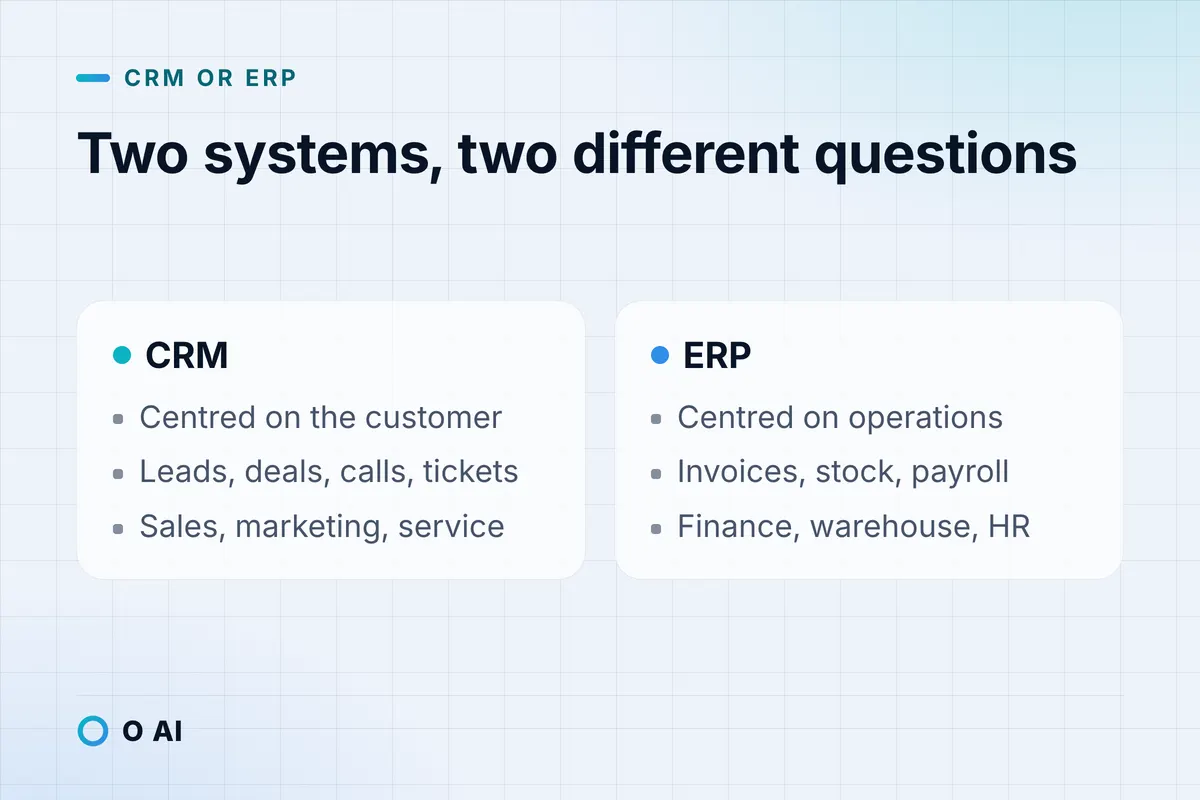
If your pain is lost leads and forgotten follow-ups, start with CRM. If it is stock, accounts and invoicing, our guide to ERP software in Saudi Arabia covers that side. Many companies end up with both, linked: the deal is won in the CRM, and the invoice is issued from the ERP or accounting system.
When does a company in Saudi Arabia need CRM?
You need a CRM once manual tracking stops working, not at a fixed company size. The usual signs are that follow-ups slip, customer information is spread across emails and spreadsheets, salespeople duplicate each other's work, and managers cannot see the pipeline.
In Saudi companies the trigger is often WhatsApp. Enquiries arrive on several phones, each salesperson answers from their own number, and nobody can tell which enquiries were never answered.
Illustrative example. A building-materials distributor in Dammam has three salespeople. Enquiries come from the website form, a WhatsApp Business number and walk-in customers. Before a CRM, each salesperson keeps their own list; when one resigns, open quotations are lost. After a simple CRM roll-out, every enquiry becomes a lead with an owner, each quotation is a deal with a value and an expected close date, and the manager reviews one pipeline every Sunday. Nothing here depends on advanced features: only on one shared record and the discipline to use it.

What Saudi rules touch your CRM data?
A CRM is mostly personal data: names, phone numbers, emails and conversation histories. That puts it under the PDPL, which SDAIA supervises [2]. SDAIA's page gives the law as issued by Royal Decree No. M/19 dated 9/2/1443 AH and amended by Royal Decree No. M/148 dated 5/9/1444 AH [2]; the article numbers below follow that amended text. As of October 2026, these are the rules a CRM set-up most often touches. This is general information; for a specific case, read the official text or ask a licensed advisor.
| Topic | What the rule says | What it means for your CRM |
|---|---|---|
| Marketing messages | Advertising or awareness messages to a person's contact details need that person's consent and a clear way to stop them (PDPL, Article 25) [2] | Store when and how each contact agreed, and give every campaign an opt-out |
| Direct marketing details | Consent must be documented so it can be verified later; the way to stop messages must be easy and simple; the sender's name must be clear (Implementing Regulations, Articles 28 and 29) [3] | Keep consent as a field with a date and source, not a note in a chat |
| Data subject requests | Requests such as access to one's data must be handled within 30 days, extendable by 30 more with notice and reasons (Implementing Regulations, Article 3) [3] | Make sure you can find, export and correct one person's full record quickly |
| Data breaches | The controller notifies the authority within 72 hours of learning of a breach that could cause harm (Implementing Regulations, Article 24) [3] | Know which vendor logs access and how fast they tell you about an incident |
| Transfer outside the Kingdom | Allowed under conditions (PDPL, Article 29); the transfer regulation relies on an adequacy list, or safeguards such as standard contractual clauses, and requires a risk assessment in some cases [2][4] | Ask where the CRM vendor stores and processes your data |
| Penalties | Violations by private entities can lead to a warning or a fine of up to SAR 5 million (PDPL, Article 36) [2] | Treat consent and access controls as part of the set-up, not an afterthought |
Two more points come up often. If the CRM sends WhatsApp messages through the WhatsApp Business Platform, Meta requires an opt-in that clearly states the person is agreeing to receive messages from your business and names your business [6]; our guide to WhatsApp chatbots for business covers the costs and data side. And if the CRM issues tax invoices, not just quotations, the invoices must meet ZATCA's e-invoicing rules, which started on 4 December 2021 and moved to integration in waves from 1 January 2023 [7][8]. In practice, many companies keep invoicing in a compliant accounting system and pass the won deal to it.
Choosing CRM software in Saudi Arabia: a checklist
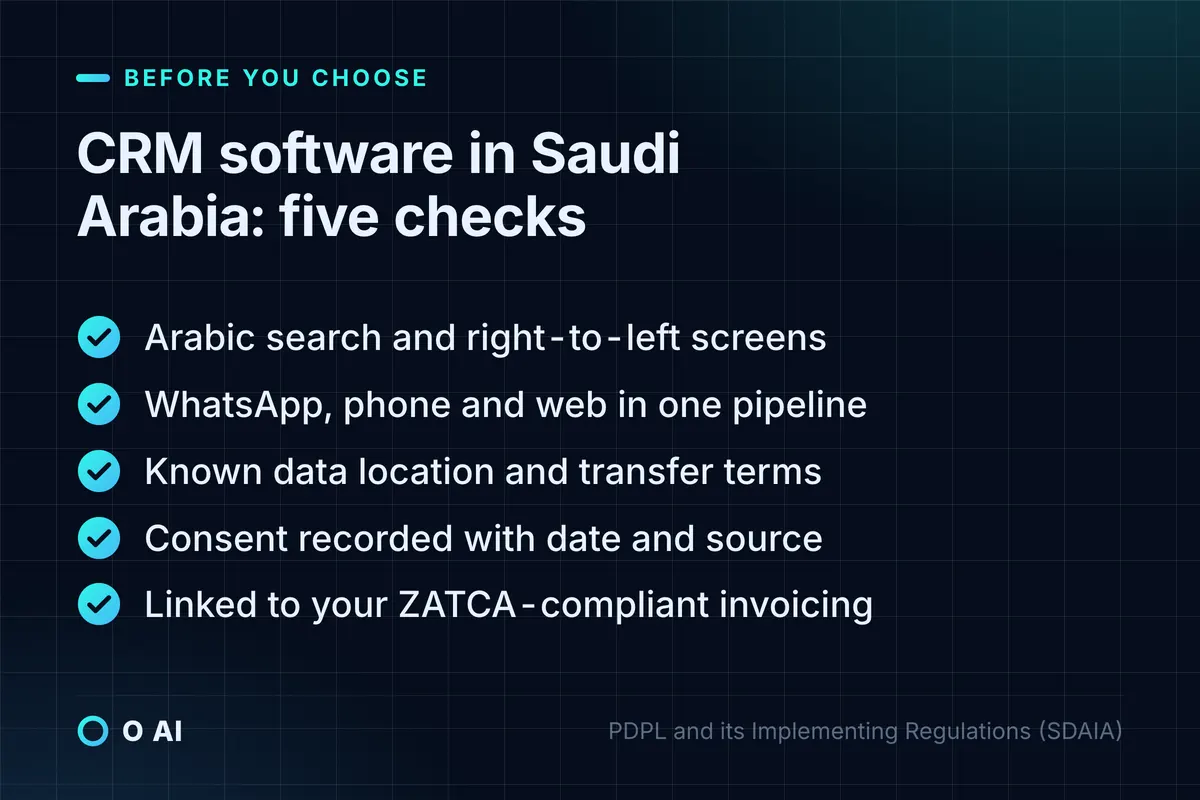
There is no single right product; the right CRM software in Saudi Arabia is the one your team will actually use with Arabic customers and Saudi rules. Compare candidates on these points, in this order:
- Arabic that works, not just a translated menu: right-to-left screens, search that finds Arabic names in their different spellings, and Arabic templates for messages and quotations.
- The channels your customers use: WhatsApp Business, phone and the website form, all landing as leads in the same pipeline.
- Data location: where the data is stored and processed, and the vendor's answer on PDPL transfers. Some global vendors now list Saudi data centres; Zoho, for example, lists Riyadh and Jeddah [5]. For what the transfer rules require, see our guide to data residency in Saudi Arabia.
- Consent and opt-out fields: a place to record consent with its date and source, and a working unsubscribe.
- Integration with accounting or ERP: won deals should become customers and invoices in your ZATCA-compliant system without retyping. ZATCA's list of e-invoicing solution providers is guidance, not a requirement [9].
- Permissions and audit trail: salespeople see their own customers; managers see all; every export is logged.
- A clean exit: you can export all contacts, deals and history in a standard format if you change vendor.
- Total cost: most CRM software is priced per user per month, so count users, add-ons and set-up time, not only the entry price.
Vendors named in this guide are examples, not recommendations, and O AI is not affiliated with any company named here.
Off-the-shelf CRM or a custom build?
A ready-made CRM fits most companies: the sales process is standard, and set-up is configuration rather than code. A custom CRM, or a custom layer on top of one, makes sense when the process is the product: for example, a contracting company whose deals depend on site visits, tenders and multi-step approvals, or a business that must combine CRM data with its own operational system.
| Choose | When |
|---|---|
| Off-the-shelf CRM | Your pipeline looks like most companies' pipelines, and you want to start within weeks |
| Off-the-shelf plus integration | The CRM fits, but it must exchange data with your accounting, ERP or WhatsApp set-up |
| Custom CRM | Your process, data rules or hosting needs do not fit any product without heavy workarounds |
Saudi software companies such as O AI build both the integrations and the custom systems; the decision should still start from your process, not from the tool.
Common mistakes when rolling out a CRM
- Buying before mapping the pipeline. If the team cannot agree on the stages of a deal on paper, the software will not fix it.
- Importing dirty data. Duplicate contacts and old spreadsheets imported on day one make the reports untrustworthy from the start.
- Too many required fields. Salespeople stop logging activity when every call needs ten fields.
- No consent record. Marketing to a contact list without documented consent conflicts with the PDPL rules on marketing messages [2][3].
- No owner. A CRM without one named person responsible for its data and reports decays within months.
Your next step
Before you compare CRM products, write down your pipeline stages and track two weeks of enquiries in a simple shared sheet: where each lead came from, who owns it and what happened next. That sheet becomes your requirements list. When you are ready to connect a CRM to your accounting, ERP or WhatsApp, our page on ERP and business systems explains how such systems are built and linked.
Frequently asked questions
What is CRM in simple words?
CRM stands for customer relationship management. In simple words, it is one shared record of every customer and every conversation with them: who they are, what they asked for, what you offered and what happens next. The term covers both the way a company manages its customers and the software that stores that information for sales, marketing and service teams.
What is the difference between CRM and ERP?
A CRM is built around customers: leads, deals, calls and support requests. An ERP is built around the company's internal operations: accounting, stock, purchasing and HR. The CRM helps you win and keep customers; the ERP records what you sold and what it cost. Many companies link the two so a won deal becomes an invoice without retyping.
Do small businesses in Saudi Arabia need a CRM?
Not always on day one. A CRM becomes worth it once follow-ups start slipping, customer details are scattered across phones and spreadsheets, or a second salesperson joins. A small team can start with a simple, low-cost CRM that covers contacts, a pipeline and tasks, and add marketing or service modules later.
Does a CRM have to comply with the PDPL?
The law applies to the company that collects and uses the personal data, not to the software itself. If your CRM holds names, phone numbers or emails of people in Saudi Arabia, you need a lawful basis for processing, documented consent for marketing messages, a way to handle access and correction requests, and attention to where the data is stored.
Is there CRM software in Arabic?
Yes. Several international and regional CRM products offer Arabic interfaces. Test more than the menu: check right-to-left layouts, Arabic search across different spellings of the same name, Arabic message and quotation templates, and whether reports and exports keep Arabic text intact.
Can a CRM send ZATCA e-invoices?
Some CRM products can issue invoices, but an invoice issued in Saudi Arabia must meet ZATCA's e-invoicing requirements. Many companies keep quotations in the CRM and issue the tax invoice from a compliant accounting or ERP system linked to it. Check which system will issue your invoices before you choose.
How this article was made: Researched from the official sources listed below, opened on 29 October 2026. Drafted with AI assistance, then checked against those sources. General information, not legal or professional advice. Illustrations were made for this article.
Sources
- What is CRM? (opens in a new tab)Microsoft · microsoft.com
- Personal Data Protection Law (opens in a new tab)Saudi Data and AI Authority (SDAIA) · dgp.sdaia.gov.sa
- Implementing Regulations of the Personal Data Protection Law (opens in a new tab)Saudi Data and AI Authority (SDAIA) · dgp.sdaia.gov.sa
- Regulation on Personal Data Transfer outside the Kingdom (opens in a new tab)Saudi Data and AI Authority (SDAIA) · dgp.sdaia.gov.sa
- Know your data center (opens in a new tab)Zoho · zoho.com
- Get opt-in for WhatsApp (opens in a new tab)Meta for Developers · developers.facebook.com
- E-Invoicing (opens in a new tab)Zakat, Tax and Customs Authority (ZATCA) · zatca.gov.sa
- Roll-out phases (opens in a new tab)Zakat, Tax and Customs Authority (ZATCA) · zatca.gov.sa
- Solution Providers Directory (opens in a new tab)Zakat, Tax and Customs Authority (ZATCA) · zatca.gov.sa
About the author
Newsletter
New guides and news by email
New guides and news about O AI, Rushd and Dalni, at most twice a month. No spam.