 AI


How to choose an AI company in Saudi Arabia: a buyer's checklist
A buyer's checklist for choosing an AI company in Saudi Arabia: the types of AI companies, ten questions to ask before signing, what the PDPL and NCA controls mean for the contract, SDAIA's accreditation for AI service providers, and a weighted scoring table.


Key takeaways
- Compare AI companies on a paid pilot with your own data and success measures agreed in writing, not on demos.
- Under PDPL Implementing Regulations Article 17, the processing agreement states purpose, data categories, period, breach notice and sub-processors.
- Explicit consent is required where decisions are based entirely on automated processing of personal data.
- SDAIA's AI service provider accreditation ends with an incentive label for the product and an accreditation certificate for the provider.
- Under NCA ECC-2:2024, in-scope entities need managed cybersecurity monitoring centres using remote access fully inside the Kingdom.
On this page
- What kinds of AI vendors work in Saudi Arabia?
- Start with the problem, not the technology
- Ten questions to ask an AI company before you sign
- What Saudi rules mean for your AI contract
- SDAIA's accreditation for AI service providers
- International frameworks worth asking about
- How to compare AI company proposals: a scoring table
- Red flags when you choose an AI company
- Your next step
This guide is by O AI, a Saudi software and AI company that builds systems, apps and AI for companies. See what we build
To choose an AI company in Saudi Arabia, start from one business problem and its data, then compare vendors on proof, not promises: a paid pilot with agreed success measures, Arabic quality tested on your own material, where data is hosted, PDPL and NCA obligations written into the contract, who owns the code, and what support looks like after launch.
This guide is for managers in Saudi companies and public bodies who are comparing AI companies for a chatbot, document automation, analytics or an AI agent. It covers the kinds of AI companies you will meet, the questions to ask, the Saudi rules that shape the contract, SDAIA's accreditation for AI providers and a scoring table. It is current as of October 2026 and is general information, not legal advice. O AI is itself a Saudi AI company, so apply the same checklist to us.
What kinds of AI vendors work in Saudi Arabia?
"AI company" covers very different businesses. Knowing which kind you are talking to tells you what to expect from the contract.
| Type | What they sell | Good fit when | Ask especially about |
|---|---|---|---|
| Consultancy | Strategy, use-case selection, readiness assessments | You do not know where AI fits yet | Who will build after the strategy |
| Product vendor (SaaS) | A ready AI product, paid per user or per use | Your need is common, such as a website chatbot | Data hosting, Arabic quality, exit terms |
| Custom developer or integrator | Builds AI into your systems and workflows | The task is specific to your process or data | Code ownership, testing, maintenance |
| Platform reseller | Licences and setup of a global AI platform | You have chosen the platform already | What they add beyond the licence |
| Data and analytics firm | Data cleaning, dashboards, prediction models | The problem is mainly in your data | Data quality work, model monitoring |
Many Saudi AI companies do more than one of these. Ask which one they are for your project.
Start with the problem, not the technology
The vendor comparison is only as good as your brief. Before you contact anyone, write down:
- The task: one process, such as answering customer questions on WhatsApp or extracting data from scanned invoices.
- The data: what exists, in which systems, in Arabic, English or both, and whether it includes personal or sensitive data.
- The measure: what "working" means, for example the share of questions answered correctly or the time saved per document.
- The owner: who in your company will run it after launch.
If you are still at the stage of asking where AI helps at all, start with our guide on how AI can help your business, one task at a time.
Ten questions to ask an AI company before you sign
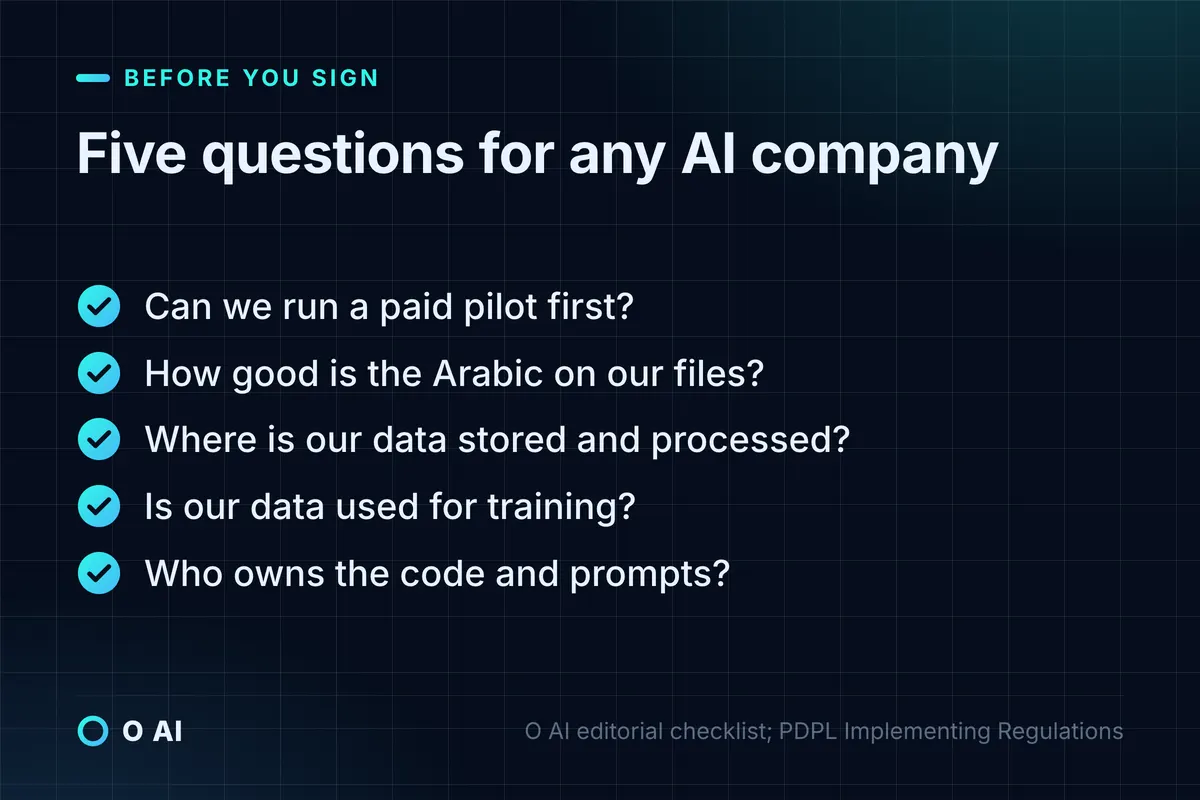
- Can we run a paid pilot first? A short pilot on your data, with success measures agreed in writing, shows more than any demo.
- How will you measure quality? Ask for a test set built from your real cases and a report of errors, not only successes.
- How good is the Arabic? Test dialect, Arabic names, mixed Arabic-English text and scanned documents from your own files.
- Which models do you use, and can we switch? You should know which third-party models process your data, and whether you can change model or vendor later.
- Where is our data stored and processed? Get the hosting location of the application, the database, backups and the model provider.
- Who can see our data, and is it used for training? The answer should be in the contract, not only in a sales deck.
- Who owns the code, prompts and configuration? For custom work, ownership and handover of the source code should be explicit.
- What happens when the AI is wrong? Ask how a human reviews or overrides decisions, and how errors are logged.
- What does support cost after launch? Models, APIs and your processes change; ask for the monthly or yearly running cost and response times.
- What can you show us that we can verify? A live product, a public case or a reference we can call, rather than unnamed claims.
Check the company behind the proposal
The answers matter less if the company cannot deliver them. Confirm the legal entity that will sign, its commercial registration and the names and roles of the people who will work on your project, not only the sales team. Ask whether any part of the work will be subcontracted, and to whom: under the PDPL Implementing Regulations, sub-processors that receive personal data must be identified in the processing agreement [4].
Ask, too, how the company handles a model provider changing its terms or prices, and how much notice you will get. A vendor that depends on a single outside model should explain its fallback plan. Finally, ask for a sample of the documentation you will receive at handover: architecture, data flows, prompts and a runbook. If the sample is thin, the handover will be too.
What Saudi rules mean for your AI contract
Most AI projects process personal data, so the Personal Data Protection Law (PDPL) usually shapes the contract. The PDPL was issued by Royal Decree M/19 dated 9/2/1443H and amended by Royal Decree M/148 dated 5/9/1444H [3].
- Choosing the vendor. Article 8 requires the controller, your company, to choose a processor that provides the guarantees needed to apply the law, and to verify its compliance [3].
- What the processing agreement contains. Article 17 of the Implementing Regulations lists the purpose, the categories of data, the processing period, breach notification to you, whether the vendor is subject to other countries' laws, and the sub-processors that will receive the data [4].
- Automated decisions. Explicit consent is required where decisions will be based entirely on automated processing of personal data, as well as for sensitive and credit data (Article 11(2)) [4].
- Impact assessment and breaches. Article 25 requires a documented risk assessment in cases such as processing sensitive data, and Article 24 requires notifying the authority within 72 hours of a harmful breach [4].
- Data leaving the Kingdom. If the vendor or its model provider processes data abroad, the transfer regulation applies; a risk assessment is required before any transfer that relies on safeguards or exemptions rather than an adequacy decision, and before continuous or large-scale transfers of sensitive data (Article 7) [5]. Our guide to data residency in Saudi Arabia explains the transfer rules.
Extra rules for government and critical infrastructure
The NCA's Essential Cybersecurity Controls (ECC-2:2024) bind government entities, their companies, and private entities that own, operate or host critical national infrastructure [6]. Subdomain 4-1 requires cybersecurity terms in contracts with third parties, including non-disclosure and secure removal of the entity's data at the end of service [6]. For managed services, cybersecurity monitoring centres that use remote access must be fully located in the Kingdom (control 4-1-3-2) [6]. The 2024 version moved data localisation controls to SDAIA's National Data Management Office [6]. If your organisation is in scope, these terms must be in the AI vendor's contract.
SDAIA's accreditation for AI service providers
SDAIA offers an accreditation service for AI service providers on the National Data Governance Platform [1]. The provider registers its organisation, appoints an AI officer, adds each product and completes a questionnaire with supporting files. After committee review the product receives an incentive label, and the provider receives an AI service provider accreditation certificate [1].
SDAIA also provides an AI ethics self-assessment tool that shows an organisation's level of ethical compliance for its AI model [2]. The pages do not state fees or validity periods. Accreditation is a useful signal to ask about, but it does not replace your own pilot and contract checks. The principles behind it are explained in our plain-language guide to SDAIA's AI ethics principles.
International frameworks worth asking about
Many buyers also ask whether a vendor follows a recognised risk framework. The NIST AI Risk Management Framework 1.0, released on 26 January 2023, is voluntary and is organised around four functions: Govern, Map, Measure and Manage [7]. NIST released a Generative AI Profile (NIST AI 600-1) on 26 July 2024 [7]. A vendor does not need to be certified against it, but it should be able to explain how it identifies, measures and manages the risks of the system it builds for you.
How to compare AI company proposals: a scoring table
Illustrative example. A company in Dammam compares three AI companies for an Arabic customer-service assistant. It scores each from 1 to 5 on six criteria and multiplies by a weight that reflects its priorities.
| Criterion | Weight | Company A | Company B | Company C |
|---|---|---|---|---|
| Pilot results on our own questions | 30% | 4 | 3 | 5 |
| Arabic quality, including dialect | 20% | 3 | 5 | 4 |
| Data hosting and PDPL terms | 20% | 5 | 3 | 4 |
| Code and data ownership, exit terms | 10% | 2 | 4 | 4 |
| Support and running cost | 10% | 4 | 4 | 3 |
| Verifiable references | 10% | 3 | 4 | 3 |
| Weighted score | 100% | 3.7 | 3.7 | 4.1 |
Company C wins here because of the pilot, even though Company B's Arabic scored higher, and Companies A and B tie for different reasons. Agree the weights before you read any proposal, so the table decides and not the most persuasive presentation.
Red flags when you choose an AI company
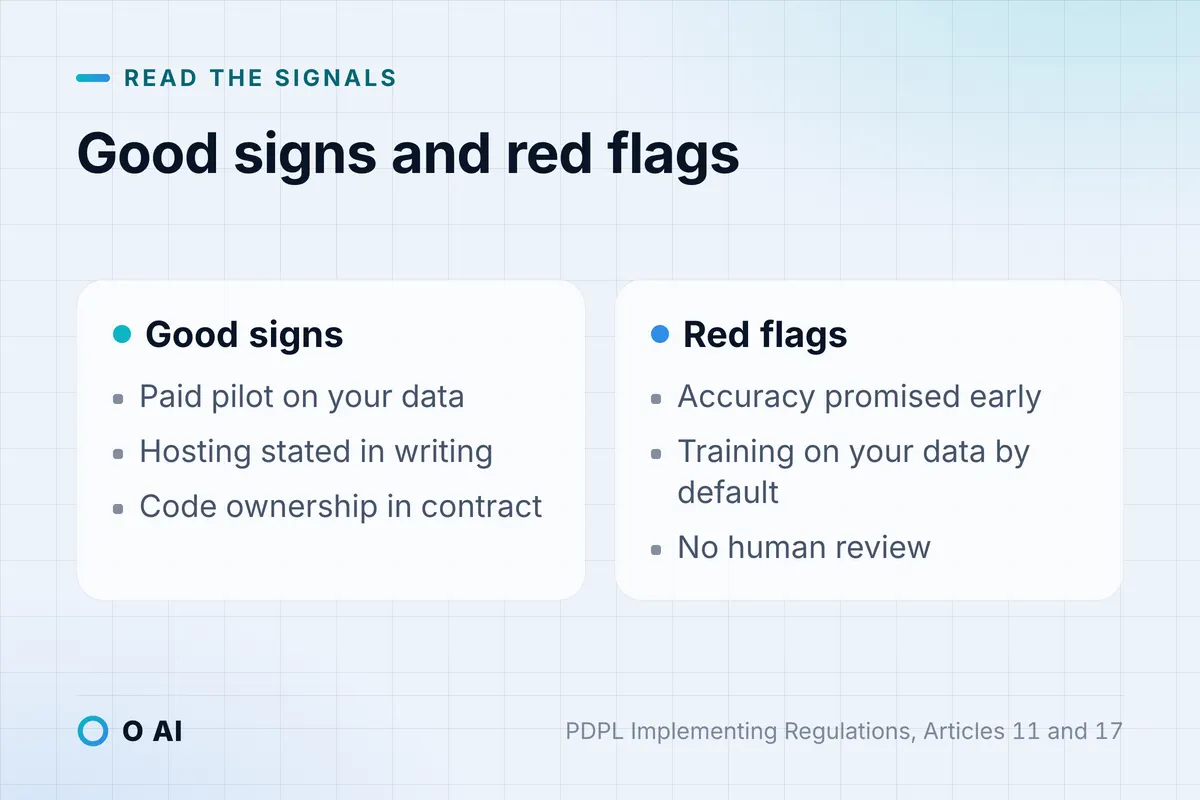
- A promise of a fixed accuracy before seeing your data. Accuracy depends on your data and your cases.
- No pilot, only a demo. A demo on the vendor's data proves little about yours.
- Vague hosting answers. "In the cloud" is not an answer for a PDPL contract [4].
- Your data used for training by default. This should be your choice, in writing.
- No human review for decisions about people. Fully automated decisions on personal data need explicit consent [4].
- Ownership left out of the contract. If it is not written, assume you do not own it.
Your next step
Write a one-page brief with the task, the data, the success measure and the owner, and send the same brief and the ten questions above to three Saudi AI companies. Ask each for a priced pilot and a draft processing agreement. If you want help turning the brief into a pilot plan, O AI's page on AI consulting and digital transformation explains how that work is scoped, and the O AI home page describes the company.
Frequently asked questions
How do I choose an AI company in Saudi Arabia?
Start with one business task, its data and a success measure. Send the same brief to several AI companies, ask for a paid pilot on your own data, and compare them on pilot results, Arabic quality, data hosting, PDPL terms, ownership of code and data, and running cost. Agree the scoring weights before reading proposals, and check any claim you can verify.
What should an AI contract in Saudi Arabia include?
Under the PDPL Implementing Regulations, the agreement with a processor states the purpose, the categories of personal data, the processing period, breach notification to you, whether the vendor is subject to other countries' laws and which sub-processors receive the data. Add code and data ownership, hosting locations, whether your data may be used for training, service levels and exit terms.
Does an AI company need SDAIA accreditation?
SDAIA runs an accreditation service for AI service providers on the National Data Governance Platform, which ends with an incentive label for the product and an accreditation certificate. The pages we read present it as a service providers apply for, not as a licence every AI company must hold. Ask a vendor whether its product is accredited, but still run your own pilot.
Can an AI company host our data outside Saudi Arabia?
It can in some cases, but the PDPL transfer regulation then applies. Transfers rely on bases such as adequacy decisions, standard contractual clauses, binding common rules or accreditation, and a risk assessment is required when a transfer relies on these safeguards or exemptions rather than an adequacy decision, and for continuous or large-scale transfers of sensitive data. Government entities and critical infrastructure operators have further NCA and SDAIA requirements.
What is the difference between an AI consultancy and an AI developer?
An AI consultancy helps you decide where AI fits, which use cases to start with and how ready your data and teams are. An AI developer or integrator builds the system: it connects models to your data and workflows, tests them and maintains them. Some Saudi AI companies do both; ask who will do each part of your project.
How long should an AI pilot take?
A useful pilot is short and focused on one task with agreed success measures and your real data. Its length depends on how ready the data is and how many systems must be connected. Agree the duration, the measures and what happens after the pilot in writing before it starts, so the result leads to a clear decision.
How this article was made: Researched from the official sources listed below, opened on 29 October 2026. Drafted with AI assistance, then checked against those sources. General information, not legal or professional advice. Illustrations were made for this article.
Sources
- AI service provider accreditation (opens in a new tab)Saudi Data and AI Authority (SDAIA) · dgp.sdaia.gov.sa
- AI ethics self-assessment (opens in a new tab)Saudi Data and AI Authority (SDAIA) · dgp.sdaia.gov.sa
- Personal Data Protection Law (Royal Decree M/19 dated 9/2/1443H, amended by Royal Decree M/148 dated 5/9/1444H) (opens in a new tab)Bureau of Experts at the Council of Ministers · laws.boe.gov.sa
- Implementing Regulations of the Personal Data Protection Law (opens in a new tab)Saudi Data and AI Authority (SDAIA) · dgp.sdaia.gov.sa
- Regulation on Personal Data Transfer outside the Kingdom (opens in a new tab)Saudi Data and AI Authority (SDAIA) · dgp.sdaia.gov.sa
- Essential Cybersecurity Controls (ECC-2:2024) (opens in a new tab)National Cybersecurity Authority (NCA) · cdn.nca.gov.sa
- AI Risk Management Framework (opens in a new tab)National Institute of Standards and Technology (NIST) · nist.gov
About the author
Newsletter
New guides and news by email
New guides and news about O AI, Rushd and Dalni, at most twice a month. No spam.