 AI


Muqeem portal for employers: iqamas, exit visas and inquiries
Muqeem is the portal Saudi establishments use for their resident employees' Passports transactions. This guide explains the packages, how Muqeem, Qiwa and Absher split expatriate management, how to plan iqama and exit visa renewals, and what a Muqeem inquiry can check.


Key takeaways
- Muqeem lets establishments view resident employees' data and complete Passports transactions without visiting the General Directorate of Passports.
- A valid work permit from Qiwa is one of the conditions for issuing or renewing an iqama, so renew and pay the permit first.
- As of October 2026, Muqeem offers Basic, Advanced and Professional packages, which differ in bulk processing, reports, API integration and users.
- The 2026 Nitaqat guide allows a work permit renewal in the green and platinum bands only if no more than six months remain on the iqama.
- Muqeem issues exit and re-entry and final exit visas for one resident or a group, and has a Visa Validity check on its home page.
On this page
- What is the Muqeem portal?
- Managing expatriates (إدارة الوافدين): which platform does what
- Iqama issue and renewal through Muqeem
- Exit and re-entry and final exit visas
- Muqeem inquiry (مقيم استعلام): what you can check
- Common mistakes in expatriate management
- A monthly Muqeem routine for HR teams
- Your next step
Muqeem is the portal that lets Saudi establishments view their resident employees' data and complete Passports transactions online, such as issuing and renewing iqamas and final exit visas, without visiting the General Directorate of Passports. It is operated by Elm and works by subscription, with Basic, Advanced and Professional packages.
This guide is for business owners and HR staff who manage expatriate employees. It explains what Muqeem does, how it fits with Qiwa and Absher Business, the order of renewals that matters for iqamas and exit visas, and how to run a Muqeem inquiry. It is current as of October 2026 and is general information, not legal advice: check the official portals before you act, and speak to a licensed adviser for a specific case.
What is the Muqeem portal?
Muqeem is a digital platform for establishments. It lets businesses and their HR departments view the data of their resident (non-Saudi) employees and complete Passports transactions electronically, without going to the General Directorate of Passports [1]. Its listed services include issuing and renewing iqamas, issuing and cancelling visas, transfer services, occupation changes and iqama printing [1]. It is operated by Elm, which is the biller for Muqeem payments, and its official address is muqeem.sa [1].
| Question | Answer |
|---|---|
| What it is | An online portal for establishments to manage resident employees' Passports transactions [1] |
| Who runs it | Elm, the biller for Muqeem subscriptions and points [1] |
| Who uses it | Establishments and their HR teams [1] |
| How it is paid for | Subscription packages, with some operations paid from a points balance [1] |
| Related channel | Absher Business, the Ministry of Interior's e-services for establishments [2] |
| Official address | https://muqeem.sa [1] |
Muqeem packages
As of October 2026, Muqeem's own site lists three packages, which it announced as its new package range [1]:
- Basic: Passports services and iqama printing for each resident one at a time, access to the Muqeem system and support, limited reports and a single user.
- Advanced: everything in Basic, plus bulk processing of Passports services for several residents in one batch, optional two-factor authentication (OTP) for the main user, a wider set of reports and a baseline of two users.
- Professional: everything in Advanced, plus API integration with the establishment's own systems, all 33 reports, digital templates for Passports transactions and a baseline of three users.
Package prices change, so take the current figures from the portal itself rather than from a guide.
Managing expatriates (إدارة الوافدين): which platform does what
Most confusion about Muqeem comes from the fact that expatriate management in Saudi Arabia is split between two ministries. The residence permit (iqama) and travel visas belong to the Passports, under the Ministry of Interior; the work permit belongs to the Ministry of Human Resources and Social Development, through Qiwa [3]. The two are linked: a valid work permit is one of the conditions for issuing or renewing an iqama [3].
| Task | Where an establishment does it | Authority |
|---|---|---|
| Issue or renew an iqama | Muqeem or Absher Business [1][2] | General Directorate of Passports |
| Final exit visa | Muqeem or Absher Business [1][2] | General Directorate of Passports |
| Exit and re-entry visa | Muqeem or Absher Business [1][2] | General Directorate of Passports |
| Issue or renew a work permit | Qiwa [3] | Ministry of Human Resources and Social Development |
| Check a worker's labour-office record | Ministry e-services, public inquiries [4] | Ministry of Human Resources and Social Development |
| View resident employees' data | Muqeem [1] | General Directorate of Passports |
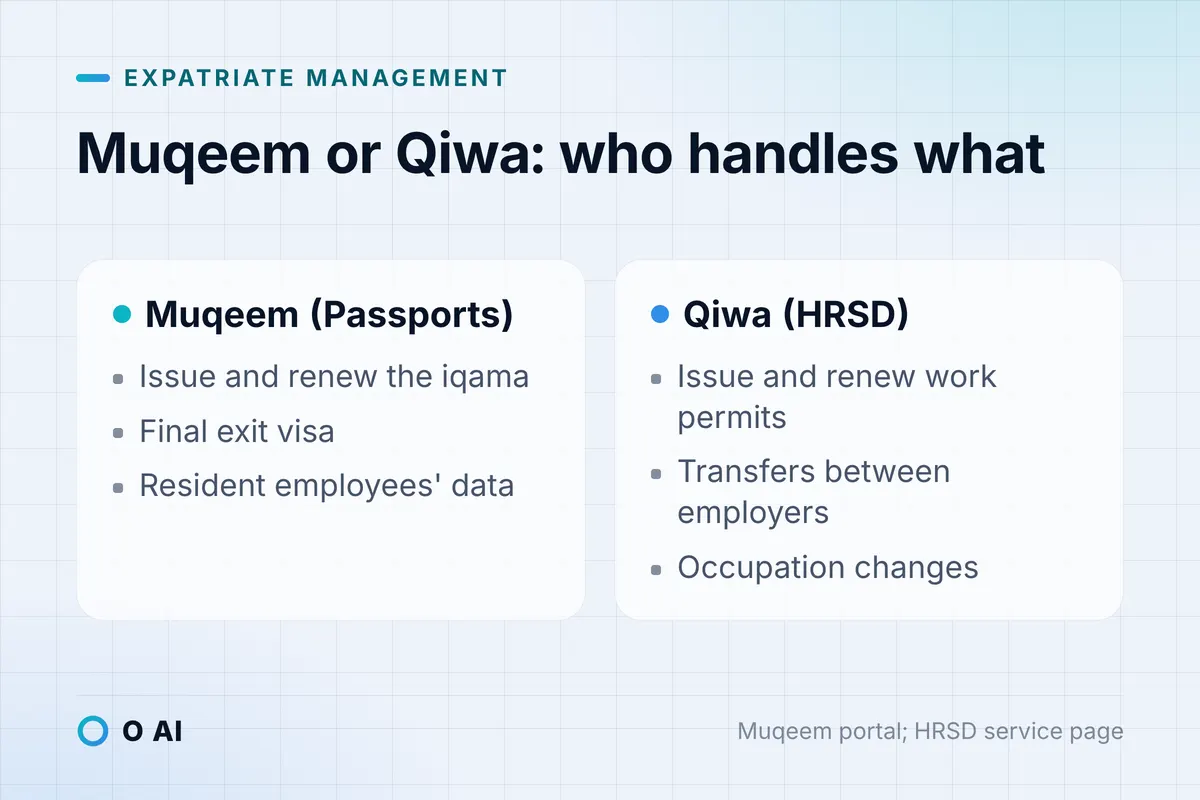
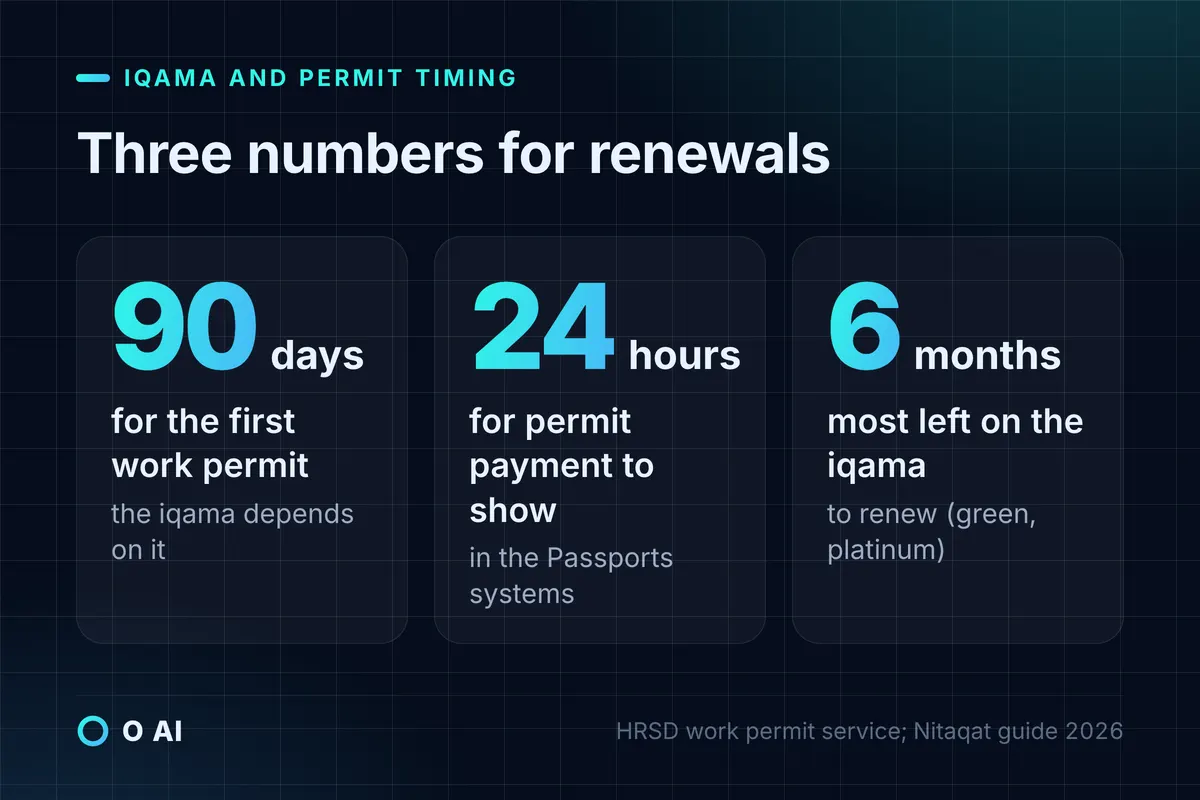
The order matters in practice. Renew the work permit in Qiwa first and pay it; the Ministry says the payment appears in the Passports systems within 24 hours [3]. Then renew the iqama in Muqeem. Starting with the iqama while the permit is unpaid means the renewal cannot meet its conditions.
Who pays
The Labor Law puts these costs on the employer. Article 40 says the employer bears the recruitment fees, the residence and work permit fees and their renewal, any occupation-change and exit-and-return fees, and the worker's return ticket when the relationship ends, unless the worker is unfit for the work or leaves without a legitimate reason [5]. Factor them into the cost of each hire; our guide to payroll calculation in Saudi Arabia shows how they sit next to salary and GOSI.
Iqama issue and renewal through Muqeem
An iqama is the resident identity card that a non-Saudi worker needs to live and work lawfully in the Kingdom. Through Muqeem the establishment issues, renews and prints iqamas electronically [1].
Issuing the first iqama. The Ministry gives 90 days for the first work permit in Qiwa [3], and the iqama depends on a valid permit, so start both as soon as the worker arrives. The Passports set the other requirements and fees for the first iqama; check them in Muqeem or Absher Business on the day the worker arrives.
Renewing. Before you renew, check that the work permit is valid and paid [3] and that the worker's passport is valid, then confirm the remaining conditions shown in Muqeem or Absher Business.
Late renewal. Renewing after the iqama has expired can bring a fine set by the Passports. The official pages we could open do not publish the amount, so check it in Muqeem or Absher Business before you pay, and set reminders well before each expiry date.
When the work permit and the iqama fall out of step
The Ministry's 2026 Nitaqat guide links the two dates: in the green and platinum bands, a work permit can be renewed provided no more than six months remain on the worker's iqama at renewal [6]. In short, plan the two renewals together, not one at a time.

Exit and re-entry and final exit visas
Establishments issue both kinds of visa electronically. Muqeem's services include [1]:
- issuing an exit and re-entry visa, for one resident or for a group of residents;
- extending an exit and re-entry visa for a resident who is outside the Kingdom;
- issuing a final exit visa, for one resident or a group, and a separate final exit service during the probation period.
The Passports set the conditions for each visa, such as the validity left on the passport and the iqama and any unpaid fees, and the system checks them when you apply. The practical point: do not let an iqama run down to its last weeks for a worker who is leaving. Check the current conditions in Muqeem or Absher Business well before the planned departure date.
Muqeem inquiry (مقيم استعلام): what you can check
A Muqeem inquiry can mean three different things, and each has its own place.
| What you want to know | Where | Notes |
|---|---|---|
| Your resident employees' data and iqama status | Your establishment's Muqeem account | Available in every package, with more reports in the higher ones [1] |
| Whether a visa is still valid | Muqeem Visa Validity service | A quick-access link on Muqeem's home and login pages [1] |
| A worker's labour-office record (permits, transfers) | Ministry e-services, public inquiries | "Expatriate employee" and "labour office services" inquiries [4] |
The Visa Validity service sits among the quick-access links on Muqeem's home and login pages, next to the services that verify Muqeem and visitor reports [1]. Inside the account, the reports on issued and active exit and re-entry visas show the status of each visa [1]. Public services change, so if the page asks you to log in, use your establishment account instead.
Common mistakes in expatriate management
- Starting the iqama before the work permit. The permit is a condition of the iqama [3].
- Missing the 90-day window for a new arrival's first work permit, on which the first iqama depends [3].
- Letting an iqama run low for a worker who is leaving, instead of planning the final exit visa early.
- Treating the two expiry dates separately. The Nitaqat renewal rules tie the work permit to the time left on the iqama [6].
- Charging the worker for iqama or permit fees. Article 40 puts them on the employer [5].
Most of these come down to dates kept in different places. An HR file that holds each worker's permit, iqama and passport dates in one record, with reminders, removes the guesswork; our guide to HR management for small businesses sets out a simple monthly routine.
A monthly Muqeem routine for HR teams
A short routine on the same day each month keeps most problems away. It needs no extra software, only the Muqeem account and the Qiwa account side by side.
- Pull the list. Export your resident employees from Muqeem with their iqama expiry dates.
- Add the permit dates. Next to each name, write the work permit expiry from Qiwa and the passport expiry.
- Flag the next 90 days. Mark every worker with any of the three dates falling in the next three months.
- Renew in order. For each flagged worker, renew and pay the work permit in Qiwa first, then renew the iqama in Muqeem once the payment shows.
- Check travel plans. Ask managers who is leaving or travelling soon, and check the visa conditions in Muqeem early for each of them.
- Review the package. Once a quarter, compare your transactions with your Muqeem package and points balance, and change package if the volume has moved.
Your next step
Log in to Muqeem, export the list of your resident employees and sort it by iqama expiry. Next to each name, add the work permit expiry from Qiwa and the passport expiry. Any worker whose two dates fall within six months of each other needs both renewals planned now. If you are choosing software to keep those dates for you, our guide to an HR system for Saudi companies lists what to ask for.
Frequently asked questions
What is the Muqeem portal used for?
Muqeem is an online portal for Saudi establishments to view their resident employees' data and complete Passports transactions without visiting the General Directorate of Passports. Typical uses are issuing and renewing iqamas, issuing exit and re-entry and final exit visas, and running inquiries on resident employees. It is operated by Elm.
What is the difference between Muqeem and Qiwa?
Muqeem handles Passports matters for resident employees, such as the iqama and the final exit visa. Qiwa belongs to the Ministry of Human Resources and Social Development and handles work matters, such as work permits, transfers and occupation changes. A valid work permit from Qiwa is one of the conditions for issuing or renewing the iqama through Muqeem.
Does every establishment need a Muqeem subscription?
Muqeem works by subscription. Its current packages are Basic, Advanced and Professional, which differ in bulk processing, reports, API integration and the number of users. Establishments can also complete many Passports services through Absher Business, the Ministry of Interior's e-services for establishments. Which channel suits you depends on how many resident employees you have and how often you transact.
What happens if an iqama is renewed late?
Late renewal can bring a fine set by the General Directorate of Passports, and an expired iqama also gets in the way of the work permit, because the two are linked. The official pages we could open do not publish the amounts, so confirm any fine in Muqeem or Absher Business before you pay, and set reminders well ahead of each expiry date.
Can an establishment issue a final exit visa through Muqeem?
Yes. Issuing a final exit visa is one of Muqeem's services, for one resident or a group, and there is a separate service for a final exit visa during the probation period. Absher Business offers final exit services too. The General Directorate of Passports sets the conditions, so check them in your account well before the worker's planned departure date.
How do I check whether an exit and re-entry visa is still valid?
Muqeem offers a Visa Validity service among the quick-access links on its home and login pages. Inside your establishment's account, the reports on issued and active exit and re-entry visas also show the status of each visa. If the public page asks you to log in, use your establishment's Muqeem account instead.
How this article was made: Researched from the official sources listed below, opened on 29 October 2026. Drafted with AI assistance, then checked against those sources. General information, not legal or professional advice. Illustrations were made for this article.
Sources
- Muqeem Portal: services, packages and Visa Validity (opens in a new tab)Muqeem (Elm) · muqeem.sa
- Absher: e-services for establishments and business owners (opens in a new tab)Ministry of Interior · absher.sa
- Issue and renew work license (service page) (opens in a new tab)Ministry of Human Resources and Social Development · hrsd.gov.sa
- E-services: public inquiries (opens in a new tab)Ministry of Human Resources and Social Development · es.hrsd.gov.sa
- Employment of non-Saudis: Labor Law Articles 32–41 (opens in a new tab)Ministry of Human Resources and Social Development · hrsd.gov.sa
- Procedural guide to the developed Nitaqat programme 2026 (opens in a new tab)Ministry of Human Resources and Social Development · hrsd.gov.sa
About the author
Newsletter
New guides and news by email
New guides and news about O AI, Rushd and Dalni, at most twice a month. No spam.