 AI


Digital transformation in Saudi Arabia: a roadmap and change management for businesses
A practical guide to digital transformation for Saudi businesses: what it means beyond buying software, the Vision 2030 and DGA context as of October 2026, a four-pillar baseline, a one-page strategy, a four-stage roadmap, an ADKAR-based change plan and two illustrative examples.


Key takeaways
- Digital transformation changes how a business serves customers and decides; buying a system is at most digitalisation of one process.
- Score your company on four pillars borrowed from the DGA's Digital Government Policy: engagement, transformation, capacity and governance.
- Run the roadmap in four stages over 12 to 24 months: prepare, pilot one or two processes, scale and connect, then improve with reporting and AI.
- The DGA's Qiyas index of government agencies' compliance with digital transformation standards reached 88.30% in its 2025 cycle, up from 87.14%.
- Change management decides adoption: explain why in Arabic, train on real cases, support staff on the floor and retire the old process on a fixed date.
On this page
- What digital transformation means for a Saudi business
- Digital transformation in Saudi Arabia: the context in 2026
- Start with a baseline: where does your business stand?
- A digital transformation strategy on one page
- The digital transformation roadmap: four stages over 24 months
- Change management: why the tools alone do not transform anything
- A change-management checklist you can use as-is
- Illustrative examples: two Saudi businesses
- Support worth knowing about, and rules to plan around
- Your next step
This guide is by O AI, a Saudi software and AI company that builds systems, apps and AI for companies. See what we build
For a business, digital transformation in Saudi Arabia means redesigning how the company sells, operates and decides with digital tools, one process at a time, rather than buying software. A workable plan has a baseline, three to five priority processes, a 12-to-24-month roadmap and a change-management plan so staff actually adopt the new way of working.
This guide is for owners and managers of small and medium businesses. It sets out the national context as of October 2026, a baseline you can score in an afternoon, a four-stage roadmap, and a change-management checklist built on two widely used models, Kotter's eight steps and Prosci's ADKAR. The company examples are hypothetical and labelled as such.
What digital transformation means for a Saudi business
The phrase covers three different levels of change, and most disappointments come from confusing them.
| Level | What changes | Illustrative example |
|---|---|---|
| Digitisation | Paper becomes a digital file | Delivery notes are scanned and stored in a shared folder |
| Digitalisation | A process runs on digital tools | Invoices are issued from the sales system and sent electronically |
| Transformation | How the business serves customers or makes money changes | Contractors order online, see live stock, pay by link and track delivery, while purchasing reorders from sales data |
Buying a system is at most digitalisation. Transformation shows up in the outcomes customers and managers notice: an order confirmed in minutes instead of a day, a month closed in five days instead of fifteen, a branch manager who sees stock without phoning the warehouse. That is why every stage of the roadmap below is measured by a process outcome, not by the number of tools installed.
Digital transformation in Saudi Arabia: the context in 2026
The national programme sets the expectations your customers, suppliers and government counterparts bring to every transaction.
- Vision 2030. The National Transformation Program, launched in 2016 as the first Vision Realization Program, lists among its strategic objectives developing the digital economy, growing SMEs' contribution to the economy, developing e-government and enhancing the ease of doing business. Its published 2025 targets included 19.2% of GDP from the digital economy and 92% digital transformation maturity for key government services [1].
- The Digital Government Authority (DGA). Established by Cabinet Resolution No. 418 dated 25/7/1442H (9 March 2021), the DGA is the national reference for digital government. Its listed tasks include setting standards and providing advisory services to government agencies and the private sector [2]. The current Digital Government Strategy covers 2023–2030 [3].
- Measured progress. The DGA's Qiyas index, which measures government agencies' commitment to digital transformation standards, reached 88.30% in its thirteenth cycle for 2025, up from 87.14% the year before, across more than 244 agencies and 95 standards. The results were published on 21 May 2026 [4].
For a private company this has two practical consequences. Government agencies are measured against digital transformation standards and more of your dealings with them happen online, so your internal processes should produce their data in digital form. And some digital steps are mandatory: ZATCA's e-invoicing Wave 25, announced on 24 July 2026, covers taxpayers whose VAT-taxable revenue exceeded SAR 187,500 in any year from 2022 to 2025, who are to connect their e-invoicing solutions to the Fatoora platform by 1 February 2027 [5]. Treat such deadlines as fixed points in your roadmap. This is general information; confirm your own obligations with ZATCA or a licensed advisor.
Start with a baseline: where does your business stand?
The DGA's Digital Government Policy groups its requirements under four pillars: engagement, transformation, capacity and governance [3]. They were written for government entities, but the same four headings make a practical self-assessment for a company.
| Pillar | Question for your company | Level 1: manual | Level 2: digital islands | Level 3: connected |
|---|---|---|---|---|
| Engagement (customers) | How do customers find you, order, pay and complain? | Phone and walk-in only | WhatsApp and a website, handled by hand | Online ordering, payment and tracking linked to sales records |
| Transformation (processes) | How does work move inside the company? | Paper forms and signatures | Separate apps; data re-keyed between them | Connected systems; data entered once |
| Capacity (people and technology) | Can staff and systems support the change? | Few digital skills; ageing devices | Some trained users; some cloud tools | A training plan, named owners, reliable infrastructure |
| Governance (data and decisions) | Who decides, and how is data protected? | No written rules | Policies exist but are not followed | Owners, access rules, retention, backups and tracked KPIs |
Score each pillar from 1 to 3 with two or three managers in the room, and write one sentence of evidence next to each score. The lowest scores that sit next to the biggest business pain are your priorities.
A digital transformation strategy on one page
A digital transformation strategy for a small or medium company does not need a consultant's deck. It needs one page that a new manager could read in five minutes:
- The business goal, in numbers. For example: cut the time from order to delivery from three days to one, or close the monthly books in five working days.
- Three to five priority processes, chosen because they cause the most pain and the change is feasible within a year.
- One measure per process, with today's value recorded as the baseline.
- A budget per stage, not one lump sum, so each stage has to earn the next.
- A sponsor and an owner for each process. The sponsor removes obstacles; the owner runs the process after go-live.
- What you will stop doing, such as a paper form, a duplicate spreadsheet or a manual approval.
To choose the priority processes, list ten candidates and score each from 1 to 5 on pain today, value if fixed and ease of change. Multiply the three scores, and start with the highest that also touches a customer or a legal deadline.
The digital transformation roadmap: four stages over 24 months
The timings below suit a company of roughly 20 to 200 staff. Smaller firms move faster; multi-branch groups need longer at stage 2.
| Stage | Timing | What you do | Output | How you measure it |
|---|---|---|---|---|
| 0. Prepare | Weeks 1–6 | Baseline, one-page strategy, sponsor, legal deadlines (such as an e-invoicing wave) | Agreed roadmap and budget for stage 1 | Baseline values recorded for each measure |
| 1. Pilot | Months 2–6 | Change one or two priority processes in one team or branch | A working new process and trained users | Measure against baseline; share of work done the new way |
| 2. Scale and connect | Months 6–12 | Roll out to all branches; connect systems; retire old forms | Data entered once and shared between systems | Share of transactions handled digitally end to end |
| 3. Improve | Months 12–24 | Reporting, automation and AI steps where the data is clean | Dashboards and automated steps with human review | Cost and time per transaction; customer complaints |
Three decisions recur at every stage. Whether to buy a package, connect what you have or build something specific is covered in our guide to custom software development in Saudi Arabia. Which kind of automation fits each step, from simple workflow rules to AI agents, is the subject of our comparison of AI agents, RPA and workflow tools. And for a first AI pilot in stage 3, our guide on how AI can help your business shows how to test one task before spending.
Change management: why the tools alone do not transform anything
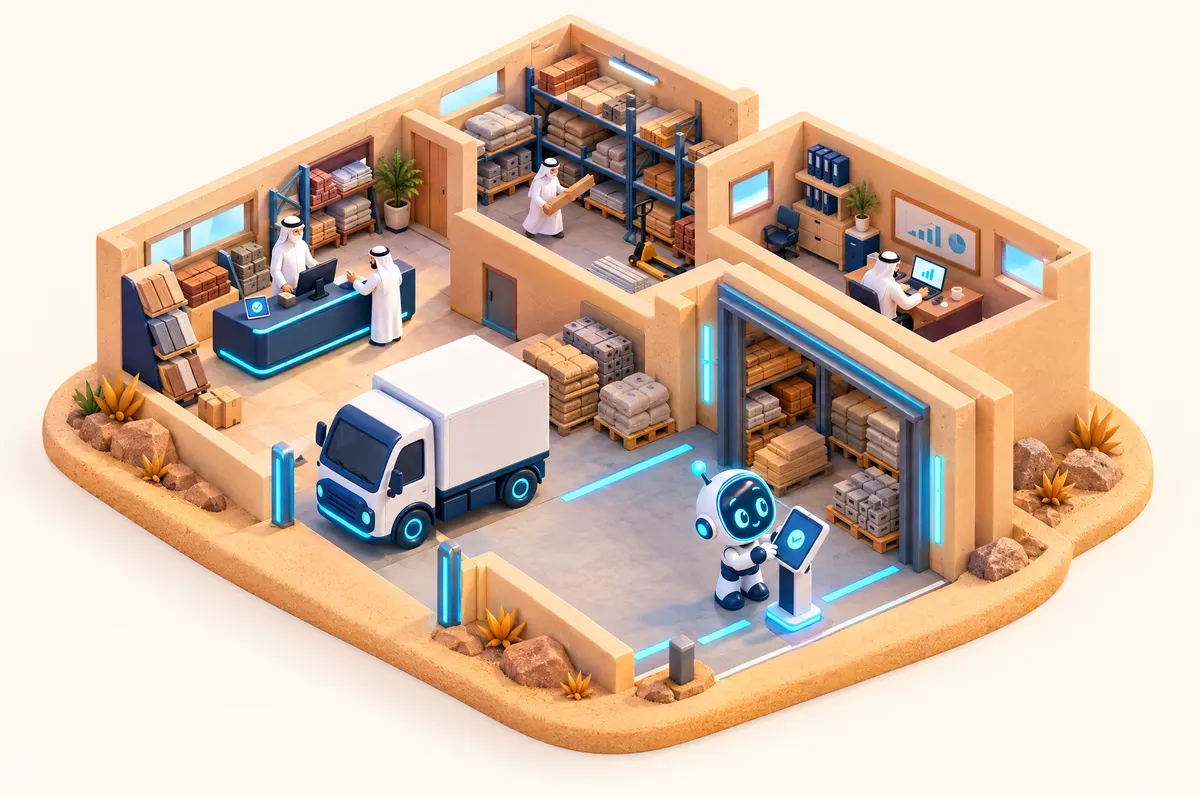
A new system changes nothing if people keep the old spreadsheet open beside it. Change management is the deliberate work of helping people move to the new way and stay there. Two models are widely used, and they work well together: one for the organisation, one for each person.
Kotter's eight steps describe how leaders drive change across an organisation: create a sense of urgency, build a guiding coalition, form a strategic vision, enlist a volunteer army, enable action by removing barriers, generate short-term wins, sustain acceleration and institute change [7].
Prosci's ADKAR model describes what each individual needs, in order, and helps find where progress is blocked by focusing on the earliest unmet element [8]. Here is how it translates into a Saudi workplace:
| ADKAR element | What the employee needs | Practical actions |
|---|---|---|
| Awareness | To understand why the change is needed [8] | A one-page explanation in Arabic: the customer complaints, the ZATCA deadline or the hours lost today |
| Desire | To choose to take part [8] | Show what gets easier for them; answer the job-security question honestly and early |
| Knowledge | To know how to work the new way [8] | Short training on real cases, Arabic quick-reference sheets, two-minute screen recordings |
| Ability | To apply it on the job [8] | A practice environment, a champion in each team, floor support for the first two weeks |
| Reinforcement | To keep going and not slip back [8] | The new measure reviewed in the weekly meeting, recognition for early adopters, a fixed date to retire the old process |
A change-management checklist you can use as-is
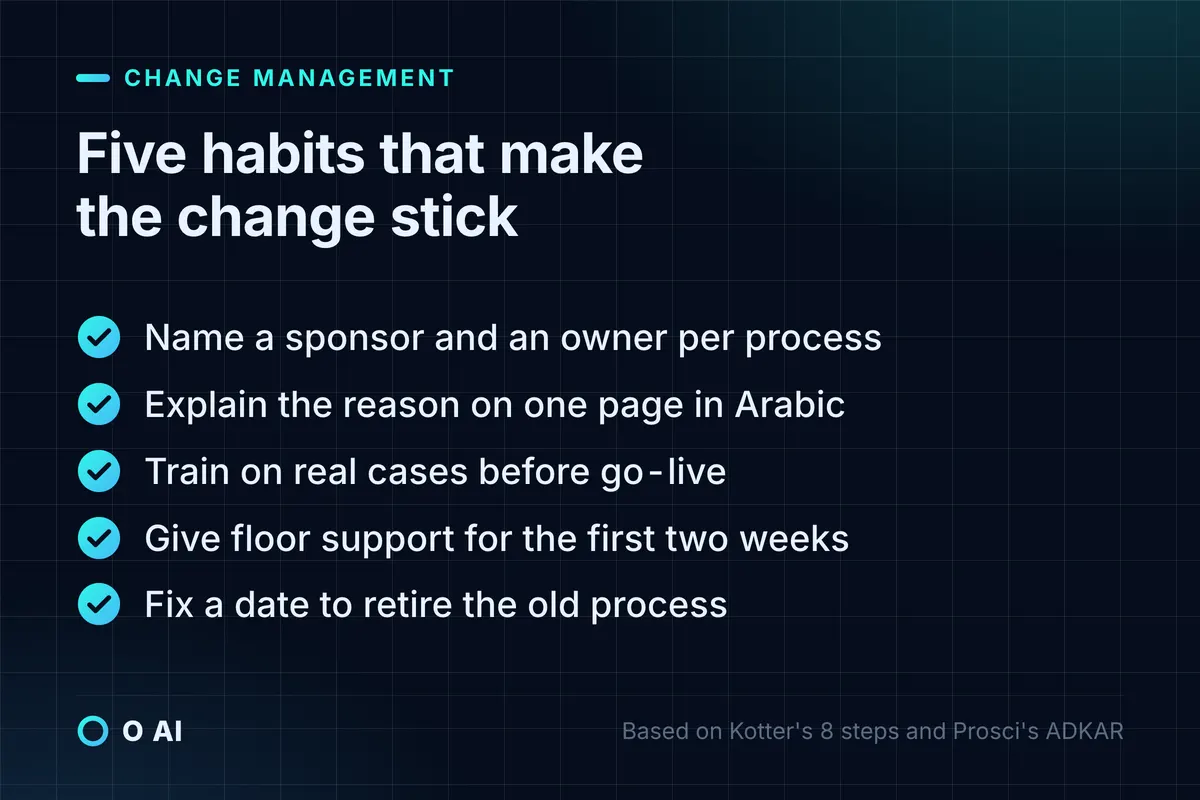
- Name a sponsor and an owner for each process before any purchase.
- Explain the reason on one page in Arabic, and repeat it in every meeting about the project.
- Involve two or three respected front-line staff in choosing and testing the new process.
- Map who is affected, how much, and what each group stands to lose.
- Answer job-security concerns directly; if roles will change, say how.
- Train on real cases before go-live, not on a vendor's demo data.
- Give floor support for the first two weeks, in person or by phone.
- Publish one early win within the first month, with its number.
- Track adoption, not just go-live: the share of work done the new way each week.
- Fix a date to retire the old process, and switch off the old form or file on that date.
- Collect complaints and fix the top three within a week.
- Review at 30, 60 and 90 days, and record what you would do differently.
Illustrative examples: two Saudi businesses
A building-materials trader in Jeddah
Illustrative example. A family-run trader with 35 staff, a yard and a showroom takes orders by phone, writes delivery notes by hand and reconciles stock in a spreadsheet each Thursday. Its baseline scores are 1 on engagement and transformation and 2 on capacity and governance.
| Measure | Baseline | After 12 months (target) | What changed |
|---|---|---|---|
| Time from order to confirmed delivery slot | 1 working day | 2 hours | Contractors order and see stock through a simple portal; the sales team confirms in the system |
| Delivery disputes per month | 18 | Under 5 | Drivers confirm delivery on a phone with a photo and the customer's signature |
| Stock count differences at month end | 4% of items | Under 1% | Goods received and dispatched are recorded once, at the gate |
| Days to close the month | 15 | 6 | Invoices, receipts and stock movements flow into accounting automatically |
The pilot in months 2 to 6 covered only delivery confirmation, because disputes were the owner's biggest complaint and drivers could be trained in a week.

A three-branch dental clinic group in Riyadh
Illustrative example. The clinics book appointments by phone and lose roughly one slot in eight to no-shows. The first priority is online booking with automatic reminders; the second is moving patient files from paper to the clinic system. Reminders and booking confirmations can run through WhatsApp; our guide to WhatsApp chatbots for business covers what to automate and what Meta charges.
Patient records are personal data, so the project plan includes the Personal Data Protection Law from day one: Article 19 requires organisational, administrative and technical measures to protect personal data, including when it is transferred, and amended Article 20 requires notifying the competent authority of a leak or unlawful access, and the patient when it could harm them [6]. In practice that means role-based access, an audit trail and a tested breach procedure before the first file is uploaded.
Support worth knowing about, and rules to plan around
- Monsha'at consultation. Monsha'at offers free one-to-one consultation sessions with certified experts for entrepreneurs and SME owners, in Arabic, booked through its Nawafth app [9]. The topics depend on each consultant's expertise, so check the available sessions.
- Monsha'at e-commerce services. Monsha'at lists e-commerce programmes for micro, small and medium enterprises, including one for converting traditional stores into e-commerce, with access to providers of electronic payment, digital marketing tools including AI-driven marketing, and e-store platforms. The requirements listed include a commercial registration [10].
- E-invoicing. Put your ZATCA integration date on the roadmap as a fixed milestone [5].
- Personal data. Plan access rights, retention and breach handling into every new system that stores customer or employee data [6].
Your next step
This week, sit down with two of your managers and score the four pillars in the baseline table. Pick the one process where a low score meets the biggest complaint, record today's number for it, and write the one-page strategy around that process alone. Then plan a three-month pilot with a named owner and a date to retire the old way. That is how digital transformation starts in practice: one measured process at a time, with people brought along deliberately. You can read about O AI, a software and AI company in Al Khobar, on our home page. Our AI consulting and digital transformation page describes the assessment we run before anything is built.
Frequently asked questions
How long does digital transformation take for a small business?
In the roadmap in this guide, a first pilot on one or two processes takes three to six months, including preparation and training. Rolling the change out across branches and connecting systems takes about another six months, and the improvement stage continues after that. Most small and medium companies should plan in a 12-to-24-month horizon, with a decision point after each stage. Fixed external dates, such as a ZATCA e-invoicing integration deadline, should be placed on the plan first.
How much does digital transformation cost?
There is no single figure, because the cost depends on which processes you change, whether you buy, connect or build systems, and how many people need training. Budget per stage rather than for the whole programme: a small pilot first, then a rollout funded only if the pilot meets its measure. Include training time, temporary floor support and the effort of cleaning data, which can cost more than the software subscription itself.
What is the difference between digitisation and digital transformation?
Digitisation turns paper into digital files, such as scanning delivery notes. Digitalisation runs a process on digital tools, such as issuing invoices from a system. Digital transformation changes how the business serves customers or makes decisions, for example letting contractors order online, see stock and track delivery, while purchasing reorders from sales data. Most companies move through all three, but only the last one changes results customers notice.
What is change management in digital transformation?
Change management is the planned work of helping people adopt the new way of working and keep using it. It covers explaining why the change is needed, involving the people affected, training them on real cases, supporting them in the first weeks and retiring the old process on a fixed date. Two common models are Kotter's eight steps, which guide leaders, and Prosci's ADKAR, which tracks what each person needs: awareness, desire, knowledge, ability and reinforcement.
Is there government support for SMEs' digital transformation in Saudi Arabia?
Monsha'at, the SME authority, offers free one-to-one consultation sessions with certified experts, booked through its Nawafth app, and lists e-commerce programmes for micro, small and medium enterprises, including one for converting traditional stores into e-commerce. Eligibility and topics vary by programme and session, so check the current details on Monsha'at's site before you plan around them. Government digital services themselves are overseen by the Digital Government Authority.
Is e-invoicing part of digital transformation?
It is a mandatory digital step, and a useful starting point. ZATCA's integration phase requires connecting your invoicing system to the Fatoora platform, issuing invoices in a specified format and adding extra fields. Wave 25 covers taxpayers whose VAT-taxable revenue exceeded SAR 187,500 in any year from 2022 to 2025, with a deadline of 1 February 2027. Compliance alone is digitalisation, though; the transformation comes from using that structured sales data to run the business better.
Who should lead digital transformation in a small company?
The owner or general manager should sponsor it, because the hardest decisions are about priorities, budget and people, not technology. Each priority process then needs one owner from the business side who will run it after go-live. The IT person or external supplier builds and supports the systems, but a transformation led only by IT risks ending with new software and old habits.
How this article was made: Researched from the sources listed below, opened on 14 October 2026. Drafted with AI assistance, then checked against those sources. General information, not professional advice. Images are AI-generated illustrations.
Sources
- National Transformation Program (opens in a new tab)Saudi Vision 2030 · vision2030.gov.sa
- About DGA (opens in a new tab)Digital Government Authority (DGA) · dga.gov.sa
- Digital transformation: strategies, policies and regulatory framework (opens in a new tab)Digital Government Authority (DGA) · dga.gov.sa
- DGA Announces Rise of Digital Transformation Measurement Index for Government Agencies to (88.30%) (21 May 2026) (opens in a new tab)Digital Government Authority (DGA) · dga.gov.sa
- ZATCA Determines the Criteria for Selecting the Targeted Taxpayers in Wave 25 for the Integration Phase of E-invoicing (24 July 2026) (opens in a new tab)Zakat, Tax and Customs Authority (ZATCA) · zatca.gov.sa
- Personal Data Protection Law, with amendments (in Arabic) (opens in a new tab)Bureau of Experts at the Council of Ministers · laws.boe.gov.sa
- The 8 Steps for Leading Change (opens in a new tab)Kotter · kotterinc.com
- The Prosci ADKAR Model (opens in a new tab)Prosci · prosci.com
- Consultation and Guidance service (opens in a new tab)Monsha'at (Small and Medium Enterprises General Authority) · monshaat.gov.sa
- E-commerce programs and services (opens in a new tab)Monsha'at (Small and Medium Enterprises General Authority) · monshaat.gov.sa
About the author
Newsletter
New guides and news by email
New guides and news about O AI, Rushd and Dalni, at most twice a month. No spam.